


This article will cover the top retail chains pos systems that optimize sales transactions, inventory control, and customer satisfaction.
When managing several locations, real-time reporting, and easy payments, the right POS solution is essential.
Such systems fosters automation and streamlined business operations and are thus, retail chains of today that are growing and require more control are highly dependent on them.
Key Points & Best POS Systems for Retail Chains
- Square POS — Easy setup, strong inventory management, and excellent for multi-location retail chains.
- Lightspeed Retail — Cloud-based, advanced analytics, and robust inventory features for large retailers.
- Shopify POS — Seamless integration with online stores, great for omnichannel retail operations.
- Toast POS — Tailored for restaurants and food retail chains, strong menu and order management.
- Clover POS — Flexible hardware options, customizable apps, and scalable for growing chains.
- Revel Systems — Enterprise-level POS with real-time reporting and multi-location support.
- Gofrugal POS — Best for large Indian retail chains, strong ERP integration and scalability.
- Zoho POS — Affordable, integrates with Zoho ecosystem, ideal for small to mid-sized chains.
- OrderZ POS — Best overall for Indian retailers, simple interface and strong billing features.
- Petpooja POS — Popular for restaurants and retail, strong menu and billing management.
10 Best POS Systems For Retail Chains
1. Square POS
Square POS is perfect for retail chains that want an easy, cost-effective growing solution that has no long-term contract commitments.
They are known for their great customer service, quick onboarding, great payment processor that is card present competitive, and for having an easy to use interface.

Square POS offers customer profile management, sales reporting, and employee permission management. Their ecosystem comprises loyalty programs, online stores, and various hardware offerings like terminals and registers.
Square POS eliminates heavy tech work for retailers with multiple locations and allows them to manage sales, stock sync across stores, and offers real time data analytics.
Square POS – Key Features
Hardware items – Merchants that sell retail Square products and Square’s retail hardware.
Easy Installation and Operation – Installation is quick and easy. The user interface is simple and requires minimal training from any personnel.
Integrated Payment Processing – Card, wallet, and contactless payments for a small, consistent fee.
Inventory Control – Maintains records of stock levels, stock depletion, and item variations by place.
Support for Multiple Locations – Unified control for sales, inventories, and personnel across multiple stores.
Sales and Performance Reports – Reports to user in real time to show sales, trends, and top selling items.
| Pros | Cons |
|---|---|
| Easy setup with no long-term contracts | Limited advanced inventory features |
| Transparent, flat-rate pricing | Higher transaction fees at scale |
| Built-in payment processing | Custom reporting is basic |
| Strong multi-location support | Add-ons increase overall cost |
| Intuitive interface for staff | Not ideal for complex retail chains |
2. Lightspeed Retail
Lightning Retail is a strong user-friendly POS for large growing retail businesses. With multiple retail locations, it offers inventory management and stock-tracking features such as bundle and matrix items.
It provides accurate, insightful reports containing data on key sales, customer, and employee behavioral trends.
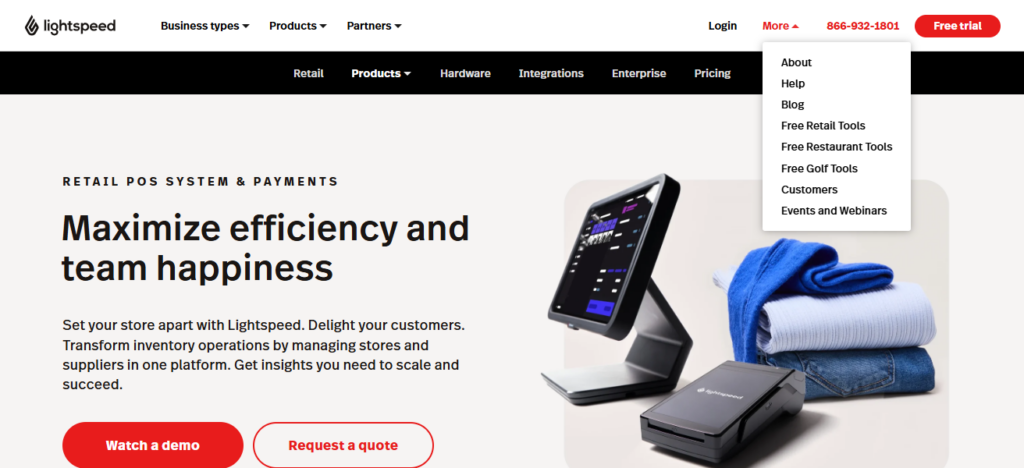
Lightspeed integrates multiple eCommerce and retail accounting platforms as well as loyalty services for unified and customizable eCommerce operations.
Designed for flexibility, strong customer support, and detaile analytics, it is ideal for medium and large retail chains. Seamlessly Clouds Lightspeed scalably offers.
Lightspeed Retail – Key Features
- Improved Inventory Features – Assists with inventory control for item bundles, serialized inventories, and matrix items.
- Management of Multiple Stores – Inventory and pricing synchronization of all retail outlets.
- Strong Analytical Functions – Reports on sales, customer data, and employee performance.
- eCommerce Integration – POS for physical and online stores is integrated seamlessly.
- Custom Workflow – Flexible configuration of the POS system to match specific retail processes to the system.
- Integrations of Other Services – Compatible with marketing, loyalty, and accounting systems.
| Pros | Cons |
|---|---|
| Advanced inventory management | Higher monthly pricing |
| Excellent multi-store controls | Steeper learning curve |
| Detailed analytics and reports | Requires training for full use |
| Strong eCommerce integrations | Extra cost for add-ons |
| Customizable workflows | Less suitable for very small retailers |
3. Shopify POS
Shopify POS integrates online and physical sales, and is therefore an excellent fit for omnichannel retail chains. It knows it’s inventory real-time, so it’s never unsyned.
Thanks to the easy to use interface, retailers can manage their customers, products, and orders from one screen. Retailers are able to customize their Shopify systems according to their needs.
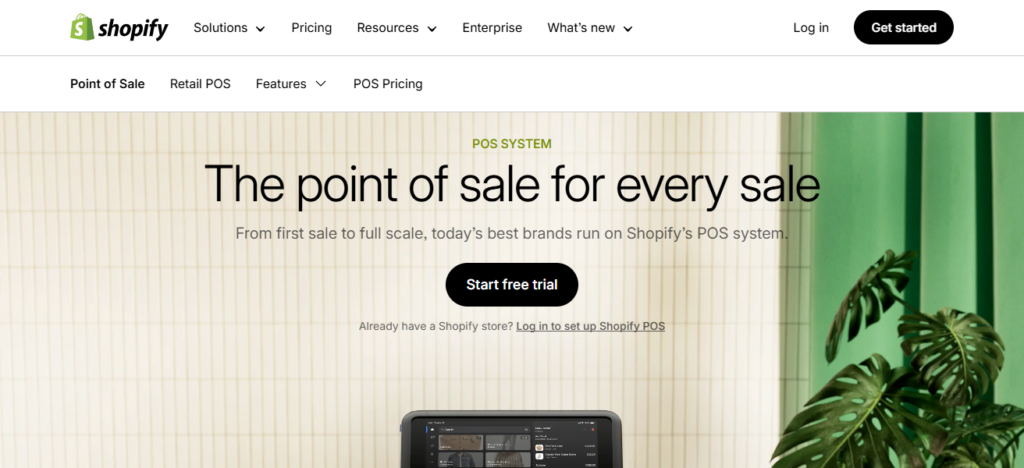
It also has a large number of payment systems, flexible hardware, and integrations. It is worth noting that their predictive analytics help to grow the merchant’s revenues. Shopify POS helps retailers of all sizes (including strategically large firms with many boutiques).
Shopify POS – Key Features
- Omnichannel Selling – Supports online, in-person, and social media sales from a single platform.
- Real-Time Inventory Sync – Automatically replenishes inventories of online and offline stores.
- Integrated Payments – Offers a variety of payment options and rapid check-out.
- Product & Order Management – Unified control from a single dashboard over product, pricing, and order management.
- App Ecosystem – Access to thousands of applications to incorporate features such as automation, reviews, and loyalty programs.
- Scalable Infrastructure – Easily transitions from a single location to multiple stores or a major retail enterprise.
| Pros | Cons |
|---|---|
| Best-in-class omnichannel support | Advanced features need higher plans |
| Real-time inventory sync | Limited offline functionality |
| Massive app ecosystem | Transaction fees without Shopify Payments |
| Scales easily for chains | Reporting can feel basic |
| Easy online + offline integration | Hardware costs can add up |
4. Toast POS
While normally supporting restaurants, Toast POS also offers services to retail chains which operate hybrids like cafes or food-adjacent stores. It integrates dashboards for payments, POS processing, inventory and customer engagement.
It also offers employee management and loyalty programs via Toast’s cloud. Its customizable hardware is durable and provides seamless service for busy operations.
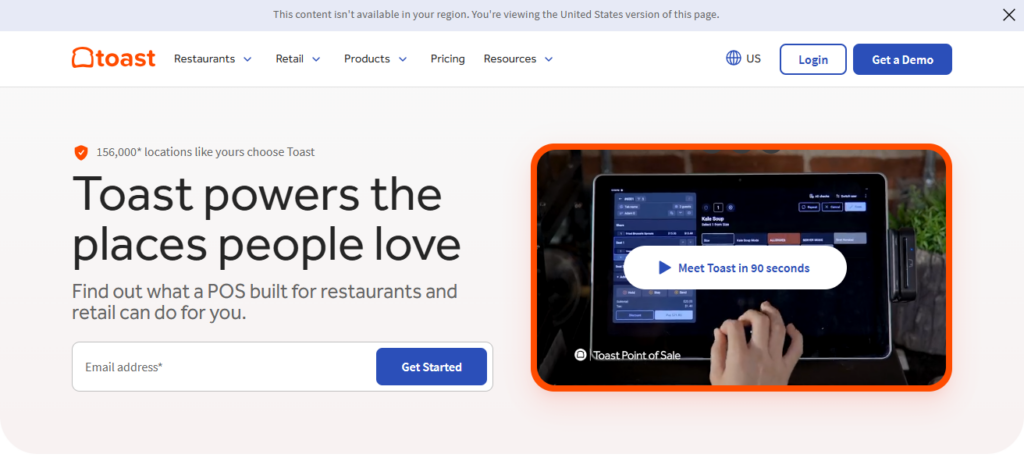
Toast also provides middleware service to food retail for seamless service during orders and rapid backend processing as well. Its deep industry knowledge translates to market leading support and responsive updates.
Toast POS – Key Features
- Hybrid Retail Support – Perfect for shops that also have a food or beverage service.
- Cloud-Based System – Real-time display of reports and data accessible from any location.
- Inventory Tracking – Effectively manages the tracking of ingredients, finished products, and overall stock.
- Employee Management – Simplifies tracking of assigned tasks, permissions, and overall employee performance.
- Loyalty & CRM Tools – Built-in features that help engage customers and encourage them to return.
- Durable Hardware – Built to withstand a high volume of sales in a busy, quick-service environment.
| Pros | Cons |
|---|---|
| Excellent for hybrid retail + food | Limited pure retail features |
| Reliable hardware performance | Long-term contracts required |
| Built-in loyalty and reporting | Less flexible customization |
| Strong employee management | Not ideal for fashion or grocery |
| Cloud-based real-time data | Pricing not very transparent |
5. Clover POS
Clover POS provides an array of adjustable systems that include both mobile and stationary hardware for retail chains. It contains core functions such as inventory handling and employee monitoring, as well as tailored pricing and payment integration.
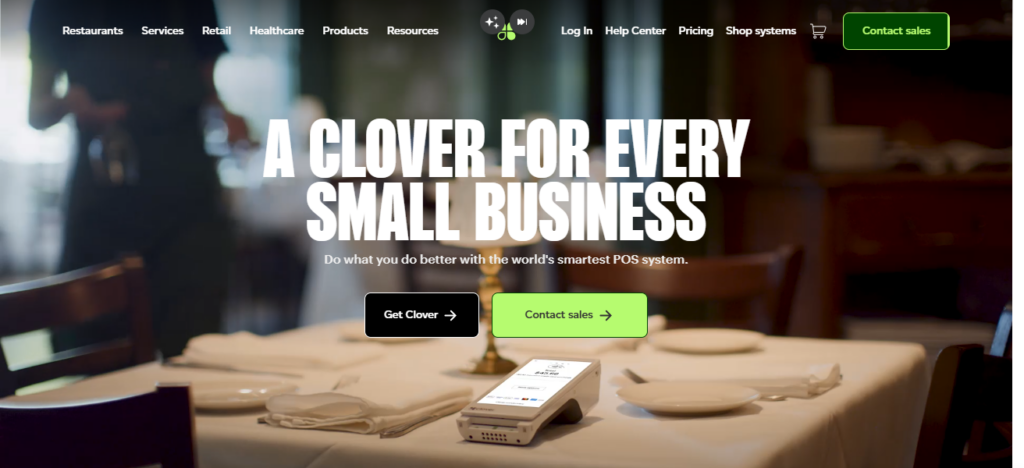
Via the Clover App Market, businesses can add apps for loyalty, bookkeeping, and promotion. The ease of use and low requirement for training is complemented by the provision of live analytical reporting to inform business decisions around sales and inventory.
The range of pricing options, and scalable systems, means that Clover can assist small single-location retailers as well as large retailers with multiple locations in their need for customizable one-stop solutions.
Clover POS – Key Features
- Flexible Hardware Options – Available configurations for portable, stationary, and complete point of sale systems.
- Inventory Management – Easily manages tracking of products, their variations, and stock quantities.
- App Marketplace – Expand features with third-party apps related to accounting, loyalty, and marketing.
- Integrated Payments – Transactions are processed quickly through built-in payment processing.
- Employee Tracking – Tracks shifts, permissions, and sales analytics.
- Real-Time Reporting – Immediate access to sales and inventory data.
| Pros | Cons |
|---|---|
| Flexible hardware options | Dependent on payment processors |
| App marketplace for customization | Apps can increase monthly cost |
| Easy to use interface | Reporting depth varies |
| Good for small to mid-size chains | Not ideal for enterprise retail |
| Scalable for growth | Limited inventory complexity |
6. Revel Systems
Revel Systems POS combines enterprise-level capabilities with a user-friendly interface, making it a great fit for larger retail chains.
The service includes advanced tools for inventory management, employee scheduling, customer relationship management, and detailed reporting.
Revel’s efficient integrations with accounting, eCommerce, and loyalty programs provide seamless functionality across multiple locations. The cloud-based system provides safe and centralized data management.
Retailers are able to analyze performance, manage employee schedules, and predict staffing needs with real-time analytics.
With adapted hardware solutions and around-the-clock support, Revel assists multi-store companies in optimizing their activities as they grow.
Revel Systems – Key Features
- Enterprise-Level POS – Large and multi-location retail chains.
- Advanced Inventory Control – Complexity of managing stock rules and managing supplier workflows.
- Employee Scheduling – Allocating and optimally staffing staff across multiple sites.
- CRM & Loyalty Tools – Customer purchase behavior tracking and retention.
- Comprehensive Reporting – Analytics related to sales, labor, and profitability.
- Cloud + On-Premise Reliability – Data security and operational continuity.
| Pros | Cons |
|---|---|
| Enterprise-grade features | High setup and monthly costs |
| Strong multi-location control | Requires long-term contract |
| Advanced reporting and CRM | Needs training for staff |
| Excellent integrations | Not budget-friendly |
| 24/7 customer support | Overkill for small retailers |
7. Gofrugal POS
Gofrugal POS helps retail chains with low-cost reliable versatile technology especially developed for businesses with large amounts of inventory.
Go Frugal delivers features like integrations for inventory control across multiple stores, promotions management, customer database management, customer management, sales reporting, etc.
Go Frugal’s solutions works well with integration for accounting, eCommerce, and payment gateways, offering seamless functionality. Go Frugal’s robust dashboard displays key metrics
like stock valuation, and daily sales variations, and help managers make data-driven decisions. Small and medium enterprises especially value Go Frugal’s simplicity and speed of deployment as it offers rich functionality with no complex workflows or significant costs.
Gofrugal POS – Key Features
- Multi-Store Inventory Sync – Syncing stock levels with all stores.
- Promotions & Offers – Ability to create discounts, promotional schemes, and loyalty rewards.
- GST & Tax Compliance – Easy tax calculation and billing.
- Sales & Stock Reports – Insights related to daily sales and inventory value.
- Accounting Integration – Integration with most accounting solutions.
- Affordable Scalability – Best suited to small and mid-sized retail chains.
| Pros | Cons |
|---|---|
| Affordable for retail chains | UI feels dated |
| Strong inventory management | Limited international presence |
| Good accounting integrations | Fewer third-party apps |
| Easy GST compliance | Customization is limited |
| Suitable for SMB retailers | Reporting less advanced |
8. Zoho POS
Zoho POST is a part of the vast software suite created by Zoho and is aimed at retailers who are in need of an integrated business system.
It provides seamless integration with Zoho’s Customer Relationship Management (CRM), inventory management, accounting, and analytics and lets the user manage all of this from one portal.
Retail chains obtain the ability to manage inventory in real-time, obtain customer profiling, and create and manage loyalty programs and promotional campaigns.
Employees appreciate the easy-to-use interface, and automation functionality to help manage repetitive tasks, for example, setting reordering alerts for inventory and automating invoicing.
Zoho is very cost-effective for chains that are looking to expand because of the scalability of their pricing and their platform is also cloud-based making it an excellent option for chains with many operational locations.
Zoho POS – Key Features
- Interconnectivity with Zoho Services – Integrative with other Zoho systems like CRM, Inventory, and Books.
- Real-Time Stock Control – Monitors stock levels, movement, and reorder points.
- Customer Profiles – Keeps record of customer’s prior transactions, shopping behavior, and preferences for more effective marketing.
- Automation Features – Stock level and reorder notifications, invoicing, and alerts automation.
- Cloud Access – Access and control multiple locations remotely in a secure manner.
- Tiered Pricing – Retail chains in expansion phase can avail for this to maximize profits.
| Pros | Cons |
|---|---|
| Deep integration with Zoho ecosystem | Works best within Zoho products |
| Affordable pricing | Limited standalone power |
| Good automation tools | UI can feel complex |
| Scalable for growing chains | Requires setup time |
| Strong inventory + CRM | Fewer POS-specific apps |
9. OrderZ POS
OrderZ POS is designed for retail chains looking for quick check-out, where speed and reliability become paramount and simple is best. OrderZ delivers a no-frills POS solution for essential sales, inventory and customer data, as well as payment processing.
OrderZ brings mobility with its tablets for pop-up, kiosk and retail floor sales. For retailers with multiple locations, OrderZ provides a consolidated performance and stock management control from a single dashboard.
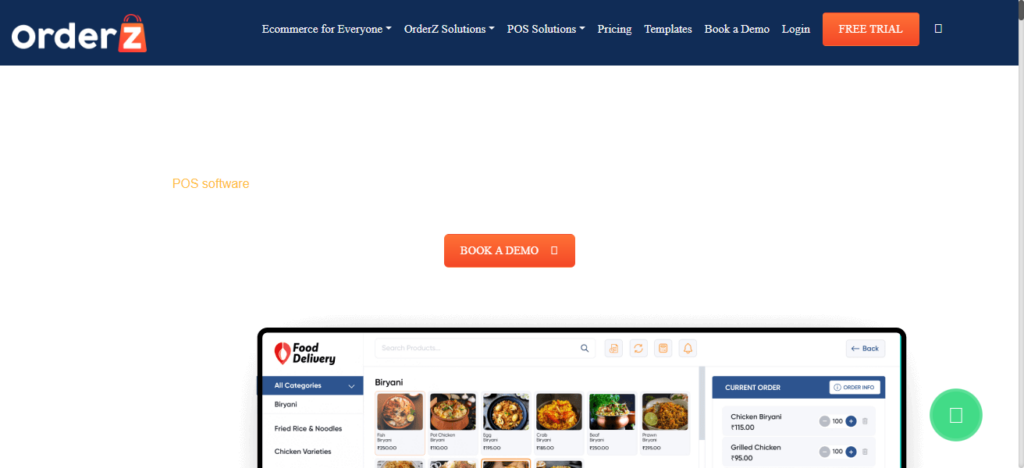
OrderZ is a great fit for retail chains looking for a simple, reliable, no-frills system optimized for sales management with flexible payment processing and easy reporting.
OrderZ POS – Key Features
- Efficient Checkout Solution – Designed with speed in mind, allowing for quicker billing times and reduced wait times.
- Tablet Mobility – Especially beneficial for use in pop-up stores, kiosk setups, or during shop floor operations.
- Unified Store Supervision – Manage and control multiple stores using a single dashboard.
- Stock Monitoring – Offers basic stock control with live tracking of stock levels.
- Versatile Payment Methods – Payment can be made using cards, UPI, digital wallets, or cash.
- Straightforward Analytics – Sales reports are concise and easy to comprehend for everyday use.
| Pros | Cons |
|---|---|
| Fast and lightweight system | Basic feature set |
| Ideal for quick checkouts | Limited advanced analytics |
| Tablet-friendly mobility | Fewer integrations |
| Easy multi-store monitoring | Not ideal for large chains |
| Simple reporting tools | Minimal customization options |
10. Petpooja POS
Petpooja POS is extremely prevalent in hospitality, yet caters to specific retail chains like pet retail and lifestyle stores, customizing inventory and billing features accordingly.
Their system is capable of managing multi-location stock management, GST filings, loyalty and digital payment integrations.

Petpooja’s platform is able to minimize and optimize the checkout process as well as automate certain backend functions such as reporting and expense management.
Connection with online order and delivery systems is essential for offering an omnichannel strategy. For regional retail chains, Petpooja’s localized functionalities like tax management, customer segmentation, and analytics make it an optimal retail solution.
Petpooja POS – Key Features
- Multi-Location Control – Centralized supervision of stock and billing.
- Electronic Billing with Integrated GST – Taxes are automatically calculated for compliance in billing.
- Stock and Vendor Management – Monitors movement of stock and associated documents with suppliers.
- Customer Loyalty – Promotions and offers are designed to gain customer loyalty.* Digital Payment Support – Accepts cards, digital wallets, and UPI transactions.
- Localized Features – Tailored to the specific retail and business requirements of the region.
| Pros | Cons |
|---|---|
| Strong GST and tax compliance | Retail features are niche-focused |
| Good for regional retail chains | Limited international scalability |
| Easy inventory and billing | Less advanced reporting |
| Supports digital payments | UI designed more for F&B |
| Affordable pricing | Not ideal for fashion retail |
Cocnlsuion
To sum up, Selecting the best retail chain pos system is essential because it increases effectiveness, precision, and customer satisfaction.
The right point of sale systems can deploy the complication of management of the inventory, enables operations, and gives valuable sales data. If you own a small chain or a large retail network, it is important to spend on the right pos system.
FAQ
A POS (Point of Sale) system processes sales transactions, manages inventory, tracks customers, and generates reports to help retail operations run smoothly.
Square POS and Clover POS are ideal for small to mid-size chains due to easy setup and affordable pricing.
Shopify POS excels in connecting online and in-store sales with real-time inventory sync.
Yes, most like Lightspeed, Revel, and Zoho POS offer multi-location inventory and centralized control.
Many POS systems include built-in processing (e.g., Square, Clover), while others integrate with third-party gateways.

