


This article will cover the Best Subscription Billing Software for SaaS Assist Organizations in Handling Recurring Payments, Automating Billing, and Streamlining Revenue Operations.
Picking the right billing platform is essential for lowering churn, managing global taxes, and scaling efficiently. From small startups to large corporations, I will cover the best tools for managing subscriptions and simplifying financial processes.
Key Points & Best Subscription Billing Software For SaaS
- Chargebee — Flexible billing automation and strong integrations
- Recurly — Advanced dunning management and churn reduction tools
- Zuora — Enterprise-grade subscription lifecycle management
- Stripe Billing — Developer-friendly APIs and global payment support
- Paddle — All-in-one SaaS commerce platform with tax compliance
- Zoho Billing — Affordable solution with CRM and finance ecosystem
- LedgerUp — Fast implementation and strong analytics dashboard
- Chargify — Tailored for complex subscription models and usage-based billing
- SaaSOptics — Financial reporting and revenue recognition focus
- Hyperline — Modern UI with automation and scalability for startups
10 Best Subscription Billing Software For SaaS
1. Chargebee
Chargebee has been in the industry for a while and has worked with a lot of mid-market and bigger SaaS companies.
Chargebee is a subscription billing and revenue management platform. Chargebee helps with revenue recognition, global ops, revenue management, and taxes and helps finance teams reduce manual work.
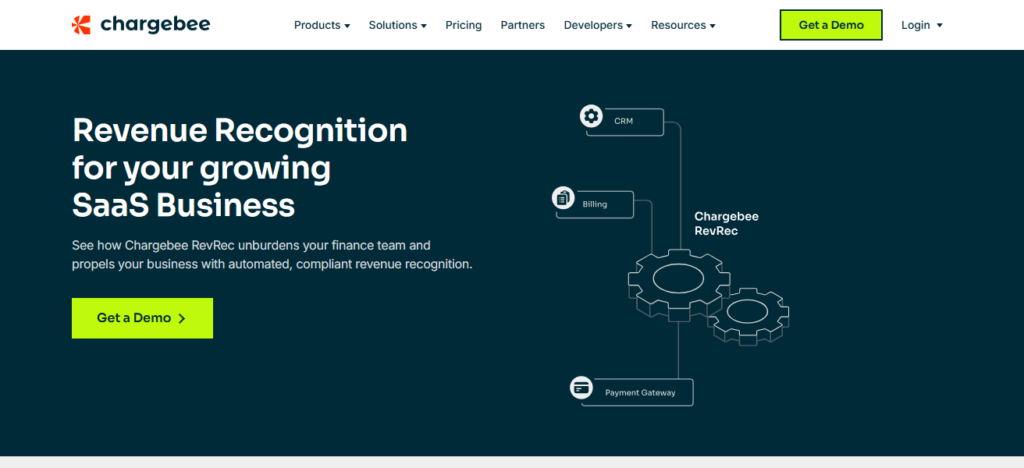
Chargebee integrates with a lot of functional and popular payment gateways for efficient proration, dunning, and plan management.
Chargebee is very flexible when it comes to p3ricing with tiered, usage, and trial pricing. chargebee has mrr and churn analytics.
Chargebee is good if you want more than just basic tools, but Chargebee is more on the expensive side for advanced features.
Features
- Fully automated recurring billing, invoicing, proration, workflows for renewals, and reduction of manual work and errors.
- Multiple pricing models are accepted and used in the software with features for usage-based, tiered, and hybrid plans.
- Global tax handling and multi-currency billing with advanced features for taxing compliance.
- Subscription operations end-to-end are integrated with Analytics, CRM, Accounting, and Payment Gateways.
| Pros | Cons |
|---|---|
| Flexible pricing models | Higher cost at scale |
| Automated billing & dunning | Complexity for small teams |
| Global compliance & multi-currency | Customization setup needed |
| Detailed analytics | Advanced features add cost |
2. Recurly
Recurly continues to be at the forefront of automation in subscription lifecycle management. Particularly, the ability to automate churn mitigation and payment recovery assists SaaS clients in the recovery of lost payments and the reduction of involuntarily lost customers.
The ability to automate payments, construct invoices, and utilize advanced payment recovery makes it preferable for subscription-heavy clients that requiring advanced customer retention capabilities.
Along with analytical tools to evaluate the financial and spending behavior of customers, Recurly synchronizes with several payment gateways.
Recurly is not as ideal when it comes to solving for advanced custom logic of enterprise contracts, but the application is exceptionally balanced considering the number of employees of most SaaS organizations.
Pricing is custom as it is revenue-based, but revenue optimization is a priority and retention and recovery is at the forefront.
Features
- Managing the full subscription lifecycle with features for automated invoicing and renewals.
- Dunning and recovery of failed payments to reduce churn and recover previously lost revenue.
- For SaaS revenue Multi-currency and Global taxes Analytics are charged.
- Dashboards and analytics with revenue metrics are available to track performance and gain insights.
| Pros | Cons |
|---|---|
| Churn reduction & payment recovery | Not ideal for complex contracts |
| Multi-currency support | Custom pricing |
| Automated invoicing & dunning | Less configurable |
| Revenue analytics | Fewer enterprise features |
3. Zuora
Large SaaS companies with advanced billing complexities, tax requirements, and global multi-entity financial operations utilize Zuora. It’s an enterprise-grade subscription and monetization platform.
Zuora automates recurring billing and manages advanced revenue recognition, has a comprehensive CPQ (configure, price, quote) workflow, and supports usage-based billing.
Deep integrations with ERPs and CRMs allow departments to maintain consistent quote-to-cash processes.
Built for scale and compliant with multi-region and high-transaction SaaS businesses, its analytics and reporting are exceptional.
However, it’s trade-off are lengthier implementation deadlines and increased costs. Therefore, it’s less accessible for smaller teams.
Features
- Enterprise-grade subscription management with full control of complex pricing, plans, and product catalogs.
- Global ERP, and CRM system Integrations for the automation of the quote-to-cash process.
- Advanced revenue recognition and compliance tools with frameworks like ASC 606.
- Multi-entity billing with global tax and currency support.
| Pros | Cons |
|---|---|
| Enterprise-grade features | Expensive |
| Complex billing support | Long onboarding |
| Revenue recognition & CPQ | Overkill for small teams |
| ERP/CRM integration | Steep learning curve |
4. Stripe Billing
Stripe Billing integrates with Stripe’s payment platform with features specifically focused on subscriptions and consumption-based billing for developers and tech-driven SaaS companies.
Stripe Billing features customizable APIs, trial and proration support, and payment method integrations.
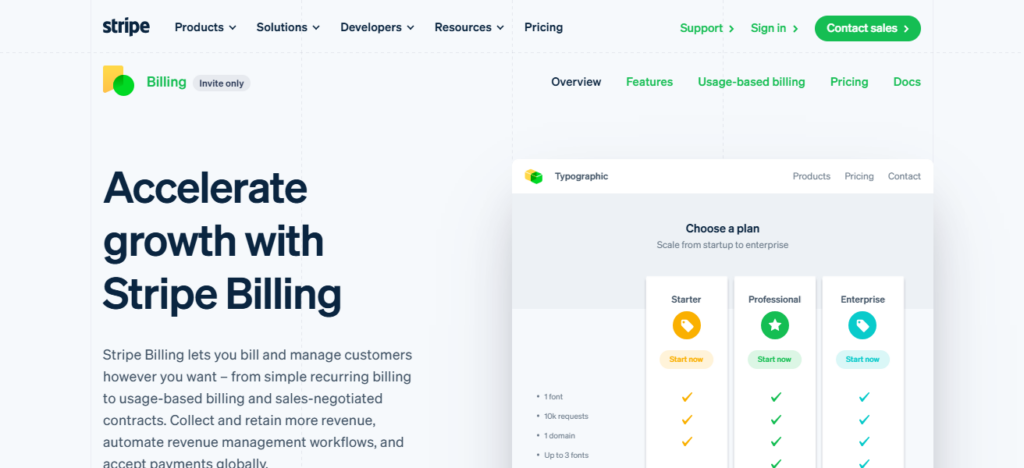
Stripe Billing offers simplified billing configuration, including support for consumption-based and tiered billing, and integrates with Stripe’s comprehensive payments platform.
Stripe Billing offers rapid setup with custom workflow controls but may require other tools for advanced revenue recognition features and more complex contract logic. Pricing is based on a pay-as-you-go structure, allowing customers to manage initial costs effectively.
Features
- Subscription and recurring billing are flexibly built APIs designed for developers.
- Part of payment methods that span the globe, along with proration, trials, and coupons, are designed directly into the software.
- Payment failures can be handled with smart retries and dunning.
- Payment and subscription reports are integrated.
| Pros | Cons |
|---|---|
| Developer-friendly API | Advanced workflows need dev support |
| Supports trials & usage billing | Extra tools needed for revenue recognition |
| Global payment integration | Limited built-in analytics |
| Fast setup | Less suited for non-technical teams |
5. Paddle
Paddle serves as the merchant of record (MoR) subscription billing platform that manages payments, global compliance, tax calculations, and billing altogether.
Because of this option, SaaS businesses can seamlessly expand internationally without the additional tax compliance burdens.
Paddle offers automated invoicing, fraud prevention, and geo-sensitive billing, all of which are useful for global SaaS businesses that want to focus on their billing and want to minimize the hassle of internal complexities.
Still, Paddle can be more expensive and offers less control than competitors because of their all inclusive pricing (transaction-based fees).
Features
- Global payment, compliance, and tax record management handled by Merchant of Record (MoR) platform.
- Various billing cycles and pricing strategies can be utilized.
- Fraud detection, prevention, and chargeback management are integrated.
- Tailoring billing experiences to specific regional markets.
| Pros | Cons |
|---|---|
| Global tax & compliance | Higher fees |
| Merchant of Record | Less control |
| Automated invoicing | Expensive for high volume |
| Fraud protection & localization | Limited custom workflows |
6. Zoho Billing
Zoho Billing (formerly known as Zoho Subscriptions) is a subscription and reccuring billing tool that is part of a larger suite of tools that Zoho offers (CRM, accounting, etc).
It offers automated billing, prorated billing, billing during a niched trial period, and billing in multiple currencies. It is a great product/service for small and mid-sized businesses.
It shows subscription data trends and automates workflows to decrease manual data entry. As other systems, Zoho Billing pricing is substanially lower than other enterprise systems
Which is common for tools that are designed to hub/satellite other systems. Zoho Billing is also suboptimal for very advanced enterprise contract scenarios.
Features
- Global payment, compliance, and tax record management handled by Merchant of Record
- Various billing cycles and pricing strategies can be utilized.
- Fraud detection, prevention, and chargeback management are integrated.
- Tailoring billing experiences to specific regional markets.
| Pros | Cons |
|---|---|
| Affordable for SMBs | Less advanced for enterprises |
| Zoho ecosystem integration | UI complexity |
| Automated billing | Limited integrations |
| Multi-currency & trial support | Fewer enterprise features |
7. LedgerUp
For B2B companies in the SaaS space with hybrid pricing and complex contracts, LedgerUp is an AI-driven subscription billing and contract-to-cash platform.
It parses signed contracts and automates 95% of the billing processes, allowing teams to transform legal billing contracts into invoices without billing configuration.
LedgerUp is equipped with revenue dashboards and Slack pricing alerts, helping to improve operational and finance revenue leaks.
It is more advanced in revenue intelligence and automation than competitors, despite being newer in the market. Companies with more complex contracts may benefit more than others.
Features
- Recurring billing that is automated is available, as well as usage-based and metered billing.
- Customer self-service portals, along with custom pricing, coupons, and trials.
- Automation of global taxes, management of multiple currencies, and proration.
- Engagement metrics dashboards along with integration into accounting or CRM software
| Pros | Cons |
|---|---|
| AI automation | Newer platform |
| Real-time dashboards | Custom pricing |
| Revenue leakage reduction | Over-engineered for simple use |
| Ideal for complex contracts | Smaller ecosystem |
8. Chargify
Chargify focuses on flexible and dynamic billing scenarios ideal for B2B SaaS and subscription companies with usage‑based, tiered, or hybrid pricing models.
It supports automated recurring billing, custom billing rules, and revenue recognition workflows, integrating with CRM and accounting tools to centralize billing operations.
Chargify’s strength is in its ability to model complex pricing plans and handle usage events smoothly, making it suitable for evolving SaaS products.
Although its pricing is custom and sometimes less transparent, its billing flexibility and analytics support product and finance teams alike.
Features
- Subscription billing management based on usage, tiers, and hybrid configurations.
- Unified product catalog for consistent definition of plans.
- Customized billing elements and add-ons for bespoke proposals.
- Subscription management via self-service customer portal.
| Pros | Cons |
|---|---|
| Flexible pricing models | Custom pricing |
| Automated billing & revenue recognition | Longer onboarding |
| Integrates with CRM & accounting | Overlapping features |
| Supports complex usage billing | Less transparent pricing |
9. SaaSOptics
SaaSOptics (often part of the Maxio suite) combines subscription billing with deep financial operations and SaaS metrics.
It automates recurring invoices and revenue recognition compliant with GAAP standards, and provides out‑of‑the‑box dashboards for MRR, churn, and ARR.
SaaSOptics integrates with accounting systems like QuickBooks and NetSuite, offering finance teams accurate financial reporting and visibility into performance.
Its focus on metrics and compliance makes it especially valuable for finance‑led SaaS businesses preparing for audits or fundraising. However, its complexity and pricing often place it above simple billing‑only tools.
Features
- Subscription oversight paired with comprehensive operational finance.
- Recognition of revenue and expenses in accordance with GAAP.
- Dashboards for key SaaS metrics (MRR, churn, ARR, LTV).
- Integration of usage tracking and billing within finance workflows.
| Pros | Cons |
|---|---|
| GAAP-compliant revenue recognition | Expensive |
| Metrics dashboards | Learning curve |
| Accounting integrations | Less developer flexibility |
| Finance-focused | Complexity for small teams |
10. Hyperline
Hyperline is a billing and revenue management solution that indeed able to handle subscriptions, usage-based, hybrid billing, and all with varying degrees of pricing logic.
Hyperline helps SaaS companies better handle quotes, contracts, invoicing, and payment collections all within one system with a strong focus on tracking usage in real-time and invoicing it correctly.
Hyperline is designed with a focus on rapid implementation, possesses various features to enable automation, and is a good option with revenue protection for fast-growing SaaS teams with a need for accurate usage metering and as little complex engineering as possible.
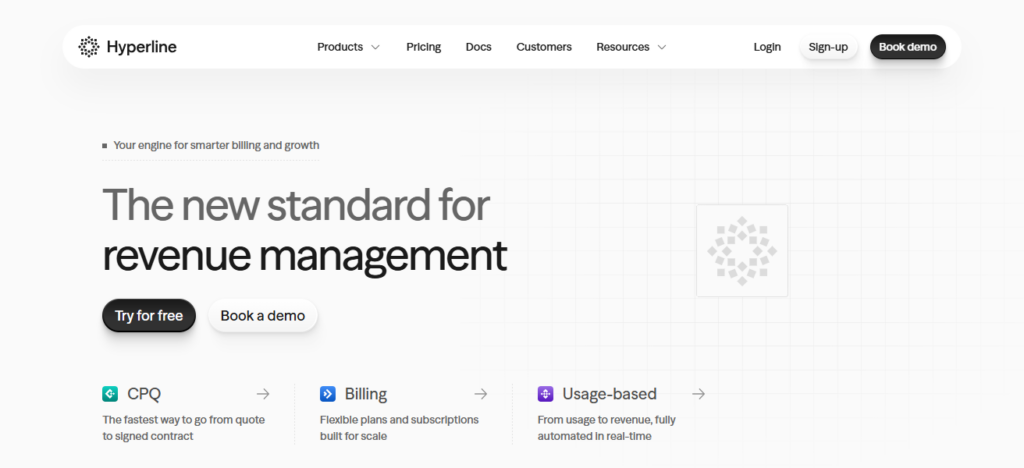
Hyperline is a relative newcomer and as such has a smaller ecosystem than older competitors, but that is made up for in SaaS automation and available flexibility.
Features
- Fully automated billing for subscriptions, usage billing, and hybrid models.
- Compliance reporting, along with revenue recognition.
- Pre-built integrations with CRM, ERP, and accounting software.
- Quick deployment with updated dashboards and automation of tasks.
| Pros | Cons |
|---|---|
| Flexible billing models | Newer platform |
| Real-time tracking & invoicing | Custom pricing |
| Automation & revenue protection | Smaller ecosystem |
| Fast implementation | Less established |
Conclusion
In conclusion, selecting the right Subscription Billing Software for SaaS is very important for automating billing and revenue management.
There are platforms that fully supports global compliance, smarter global revenue management, and more actionable analytics.
Regardless of the situation, Chargebee, Zuora, Stripe Billing and Paddle are important for streamlining and scaling SaaS operations.
FAQ
It’s a platform that automates recurring billing, invoicing, and revenue management for SaaS companies.
To reduce manual billing errors, manage subscriptions efficiently, and track revenue metrics.
Look for automated billing, multi-currency support, revenue recognition, dunning management, and analytics dashboards.
Zoho Billing and Stripe Billing are affordable and easy to implement for smaller teams.
Zuora and Chargebee are ideal for complex enterprise-level billing and global operations.

