



This article will focus on leading crypto fraud detection software platforms assisting crypto exchanges, financial institutions, and investigators with identifying suspicious transactions, money laundering, and regulatory compliance.
Given the increase in crypto-related scams and illicit activities, fraud detection solutions help in protecting digital assets and sustaining trust in blockchain ecosystems.
Key Points & Best Crypto Fraud Detection Platforms
Chainalysis — Industry leader in blockchain forensics, widely used by governments and exchanges.
Elliptic — Strong AML compliance and risk monitoring for crypto businesses.
CipherTrace — Advanced fraud detection with transaction risk scoring.
Crystal Blockchain — Real-time analytics and wallet monitoring for suspicious activity.
Arkham Intelligence — AI-powered blockchain intelligence for fraud detection.
TRM Labs — Comprehensive fraud and compliance monitoring with case management tools.
Bitquery MoneyFlow — Transaction tracing and suspicious wallet analysis.
Scorechain — Risk scoring and compliance solutions for crypto assets.
Fraud.net — AI-driven fraud prevention tailored for crypto exchanges.
Coinfirm — AML and fraud detection platform with strong regulatory integration
10 Best Crypto Fraud Detection Platforms
1. Chainalysis
Chainalysis is an industry frontrunner in blockchain intelligence, utilized by crypto exchanges, officials, and law enforcement for tracking crypto movements, detecting fraud, and compliance.
Their tools like Reactor and KYT (Know Your Transaction) offer advanced transaction tracking, wallet clustering, risk assessment and scoring, and alerts for ransomware, sanctioned, and illicit money flow.
Their vast multi-chain and token coverage enables them to assist teams in examining intricate fraud patterns, funding recovery, and global regulatory compliance, solidifying their position as an industry leader in enterprise crypto protection.
Features Chainalysis
- Real-Time Transaction Tracking: Monitors crypto transfers over multiple chains and provides live risk evaluations.
- Clustering of Wallets Attribution: Connects and analyzes behavioral patterns among grouped addresses.
- Tools for Investigation: Provides comprehensive tracking for forensic assessments of thefts and hacks.
- Compliance with Regulatory Requirements: Supports KYC/AML regulations for financial institutions and exchanges.
| Pros | Cons |
|---|---|
| Industry leader trusted by governments and law enforcement | High pricing, less suitable for startups |
| Excellent wallet clustering and transaction tracing | Complex interface for beginners |
| Strong real-time monitoring (KYT) | Limited transparency on scoring logic |
| Wide blockchain and token coverage | Custom reports may require training |
2. Elliptic
Elliptic, one of the largest blockchain analytics companies specializing in the Anti Money Laundering (AML) and fraud detection in digital assets, provides analytics services such as wallet screening and transaction analysis across a range of blockchain networks.
Elliptic’s analytics services are used by financial institutions and exchanges for regulatory compliance enforcement and real-time monitoring of high-risk addresses and illicit activities, including cross-chain fraud, NFTs, DeFi, and global enterprise client sanctions.
Features Elliptic
- Cross-Chain Analytics: Identifies risk across different blockchains and asset types.
- Dynamic Wallet Risk Score: Assesses and updates the risk score of a wallet based on its transaction history.
- Identifies Risk in DeFi and NFTs: Identifies and flags risky behaviors within decentralized applications.
- Screening for Sanctions: Identifies ties to sanctioned individuals and organizations.
| Pros | Cons |
|---|---|
| Strong cross-chain and DeFi risk detection | Enterprise-focused pricing |
| Advanced AML and sanctions screening | UI can feel data-heavy |
| Reliable NFT and smart-contract risk analysis | Limited self-serve investigation tools |
| Trusted by banks and financial institutions | Smaller community than competitors |
3. CipherTrace
CipherTrace, which is a subsidiary of Mastercard currently, provides clean crypto and anti-money laundering compliance solutions to firms and governmental bodies to identify and analyze suspicious behavior, money laundering, and fraud in crypto.
Their tool provides fraud detection case studies, transaction tracing, blockchain wallet and crypto exchange attribution, and fraud detection pattern analysis and scoring.
Through transaction details and risk analysis, case management, and compliance reporting, anti-money laundering personnel, banks, and crypto service providers manage risk and obtain greater visibility into the digital transaction activities and transparency compliance efforts in international markets.
Features CipherTrace
- Analyses transactions forensically: Tracing a blockchain to spot illicit activity.
- Tools for Compliance on Anti-Money Laundering: Assists organizations in maintaining compliance with anti-money laundering legislation.
- Integrating with APIs: Unites with enterprise frameworks for supervision and reporting.
- Attribution of wallets and exchanges: Identifies wallets associated with known entities.
| Pros | Cons |
|---|---|
| Backed by Mastercard credibility | Less innovation since acquisition |
| Robust compliance and forensic reporting | Slower product updates |
| Good API integrations for enterprises | Interface not very intuitive |
| Strong exchange and VASP coverage | Limited DeFi analytics depth |
4. Crystal Blockchain
Crystal Blockchain, made by Bitfury, is one of the leading fraud detection, compliance, and forensic investigation tools in the industry.
It offers multifaceted blockchain analytical capabilities and offers support for fraud and forensic investigations, and compliance.
It assists analysts in tracking fraud through fund flow visualization and complex money flow monitoring in real-time.
The platform’s features, such as AML/KYC compliance and screening against sanctioned addresses, make it valuable to regulators
Investigators, and crypto exchanges in tracking and reporting suspicious activity, tracing illicit crypto transactions, and complying with global reporting regulations.
Features Crystal Blockchain
- Illustrative Mapping of Transactions: Visual aids such as flow charts for easier tracking of funds channel.
- Support for Multiple Chains: Provides analytics across the major blockchains.
- Real-Time Screening for AML: Identifies and flags instantaneously risk and compliance challenges.
| Pros | Cons |
|---|---|
| Clear visual transaction flow mapping | Smaller chain coverage than leaders |
| Effective AML and risk scoring tools | Less known outside compliance sector |
| Useful for forensic investigations | UI feels dated |
| Backed by Bitfury expertise | Limited AI-driven insights |
5. Arkham Intelligence
Arkham Intelligence is an example of a blockchain analytics tool that combines artificial intelligence and blockchain data to link wallet addresses to real-world counterparts and expose transaction histories.

Its profilers and visualizers analyze wallet and dApp-counterparty interactions. Along with insights into crypto flows and address labeling, disparate crypto behaviors and fraud are easier to flag.
Its model of decentralized intelligence and data from the community makes it available to smaller teams and investigators.
Features Arkham Intelligence
- Entity Profiling: Appends real-world identities to anonymized blockchain address records.
- AI-Driven Insights: Proprietary machine learning for enhanced pattern analysis.
- Interactive Visualizers: Analyze and interact with transaction visualizations.
- Community Data Contributions: Utilizes crowd-funded data and analysis.
| Pros | Cons |
|---|---|
| Entity-level wallet labeling | Accuracy depends on community data |
| AI-powered visual analytics | Limited formal compliance tools |
| More affordable for individuals | Not regulator-first |
| Strong on-chain transparency | Risk of mislabeling addresses |
6. TRM Labs
TRM Labs provides blockchain intelligence and fraud detection tailored to support AML compliance, risk mitigation, and real-time fraud monitoring.
Their analytics tools monitor and analyze wallet activity across multiple chains, provide risk assessments to entities, and notify teams of potential fraud.
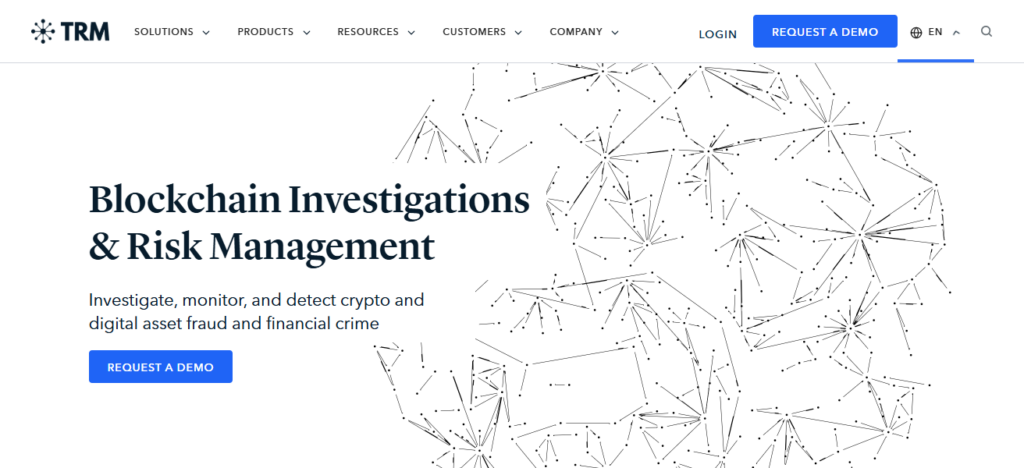
Financial institutions, exchanges, and law enforcement agencies use TRM’s forensics and monitoring tools to detect and trace the movement of fraudulent funds, perform sanction screenings, and create compliance reports.
Due to its extensive chain coverage and scalable security framework, it is a valued provider for corporate-grade crypto investigations.
Features TRM Labs
- Real-Time Risk Monitoring: Active monitoring of wallet behaviors.
- Cross-Chain Forensics: Movement tracking across multiple chains.
- Sanction & Crime Screening: Identification of at-risk entities related to criminal activity.
- Regulatory Reporting: Compliance documentation support.
| Pros | Cons |
|---|---|
| Excellent real-time risk monitoring | Expensive for small firms |
| Strong law-enforcement collaboration | Requires onboarding support |
| Broad blockchain coverage | Less focus on UI simplicity |
| Advanced sanctions and terrorism tracking | Limited public documentation |
7. Bitquery MoneyFlow
Designed to analyze and investigate the flow of money across various blockchain networks, Bitquery MoneyFlow aids forensic teams and analysts in visually tracking the movement of money and building transaction reports in a no-code environment.
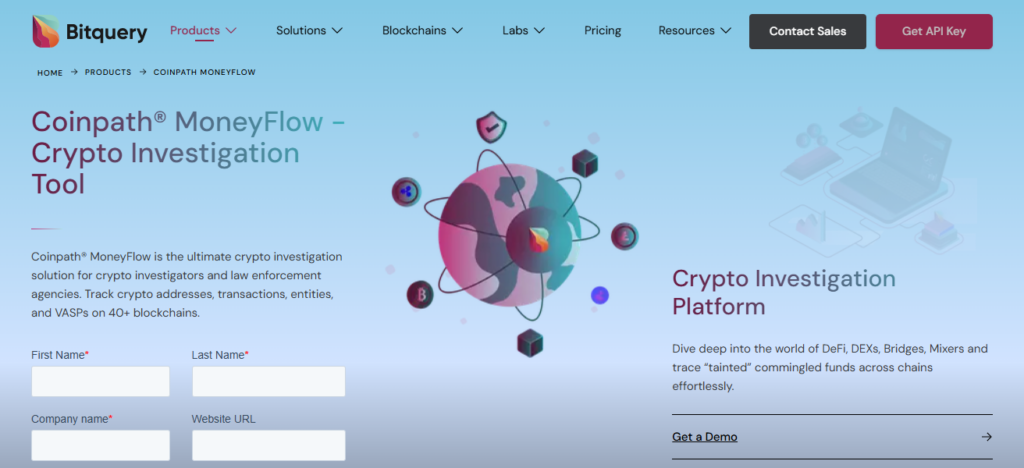
It provides tools for building reports on the movement of crypto assets through mixers, exchanges, bridges, and other DeFi (Decentralized Finance) platforms.
MoneyFlow, in combination with enriched data from Bitquery’s APIs, assists sophisticated fraud detection and analysis, suspicious pattern identification, and the tracking of illicit money flows, while also assisting customized queries and integrations.
Features Bitquery MoneyFlow
- Visual Fund Flow Tracking: Visualization of wallet and bridge fund movement.
- No-Code Investigation: Case-building without coding.
- Multi-Chain Coverage: Multiple blockchain and DeFi protocol support.
- Custom Query Support: Customized investigations for specific queries.
| Pros | Cons |
|---|---|
| Powerful visual fund-flow analysis | Requires analytical knowledge |
| No-code investigation workflows | Not beginner-friendly |
| Strong multi-chain and bridge tracking | Limited compliance reporting |
| Highly customizable queries | Less entity labeling than competitors |
8. Scorechain
Scorechain develops blockchain analytics and compliance tools that allow institutions to monitor crypto transactions and assess risk in real time.
Its system includes wallet and transaction screening, risk scoring, and visualization tools across several assets and chains to trace movements and identify potential fraud and money laundering.
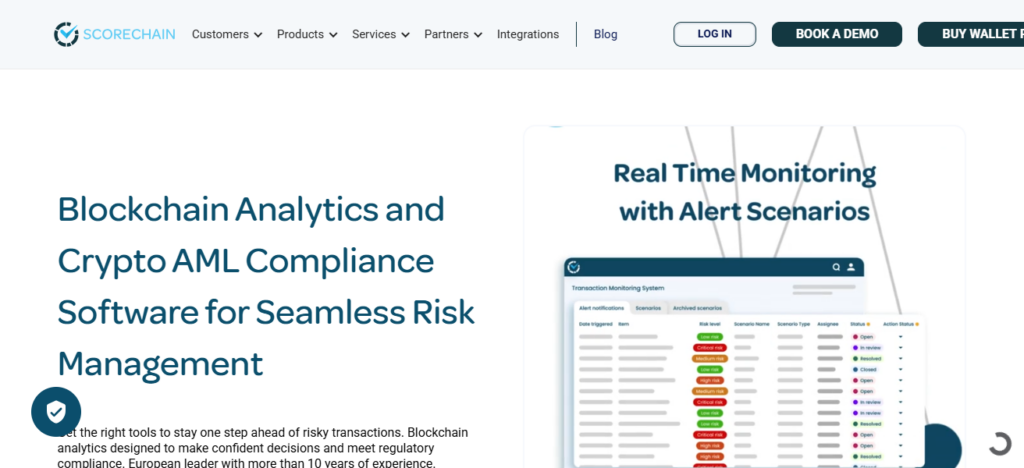
Scorechain’s solutions also aid in regulatory compliance with AML/KYC standards and offer customizable alerts for a global clientele that includes exchanges, financial institutions, regulators, and compliance teams.
Features Scorechain
- Wallet & Transaction Screening: Real-time detection of anomalous activity.
- Risk Scoring Engine: Provides risk quantification on entities.
- Visualization Dashboards: Visuals for transaction and asset movement.
- Compliance Reporting: AML and other regulatory compliance support.
| Pros | Cons |
|---|---|
| Strong AML/KYC compliance focus | Smaller brand recognition |
| Flexible risk scoring engine | UI lacks advanced visuals |
| Good regulatory reporting tools | Limited DeFi analytics |
| Supports many digital assets | Fewer AI-driven insights |
9. Fraud.net
Fraud.net’s AI-native fraud prevention and anti money laundering (AML) solutions combine machine learning, continuous monitoring, and risk decisioning, to offer fraud detection and stopping ability for digital transactions.
Enterprise grade has built the platform to help manage and examine thousands of fraud detection and prevention workflows.

On top of that, in facilitates regulatory compliance and reduction of false positive detection for billions of data transactions.
It AI models aid customer onboarding, continuous monitoring, and behavior detection to help manage the fraud risk for fintech and financial services firms.
Features Fraud.net
- AI-Driven Detection: Identification of outliers with machine learning.
- Behavioral Analytics: Detection of outliers in transaction activity for users.
- False-Positive Reduction: Risk warning improvements in accuracy.
- Enterprise Workflows: Automation for case management and investigations.
| Pros | Cons |
|---|---|
| AI-driven fraud detection models | Not crypto-native |
| Excellent behavioral analytics | Limited blockchain tracing depth |
| Reduces false positives effectively | Better for fintech than exchanges |
| Strong enterprise automation tools | Requires integration effort |
10. Coinfirm
Coinfirm is a provider of analytics on the blockchain and anti-money laundering risk management services.
They have a number of tools available, such as risk scoring, transaction monitoring, and reporting solutions for compliance.
Institutions use their platform to screen transactions, assess risk on the counterparty, and prepare detailed countermeasure reports.
Coinfirm’s services have been utilized by exchanges, financial institutions, and blockchain protocols.
Coinfirm combines blockchain and compliance data in order to identify, support, and fulfill the requirements for compliance in different jurisdictions.
After being acquired by Lukka, Coinfirm is integrated into the analytics of broader enterprise crypto data services.
Features Coinfirm
- AML Risk Scoring: Measures transactions and entities against risk criteria.
- Compliance Reports: Produces reports to be submitted to regulators.
- Counterparty Risk Assessment: Assesses wallets and partners.
- Integrated Data Ecosystem: Operates across unified compliance instruments.
| Pros | Cons |
|---|---|
| Detailed AML risk scoring system | Interface can feel complex |
| Strong regulatory reporting tools | Less advanced visualization |
| Widely used by exchanges | Slower investigation workflows |
| Integrated with Lukka ecosystem | Limited real-time alerts |
Conclusion
To summarize, the Best Crypto Fraud Detection Platforms are essential for protecting the digital assets ecosystem as they monitor activities, stop financial crimes, and help with compliance.
Chainalysis, Elliptic, and TRM Labs provide cutting-edge analytics, monitoring, and real-time scoring. These services assist exchanges, financial institutions, and investigators in protecting the crypto ecosystem and fostering long-term trust.
FAQ
Exchanges use them to screen wallets, monitor transactions, identify high-risk activity, and meet AML/KYC compliance standards.
Some, like Arkham Intelligence or Bitquery MoneyFlow, offer more accessible interfaces, but most are designed for enterprises and compliance teams.
Yes — leading platforms (Chainalysis, Elliptic, TRM Labs) support many chains including Bitcoin, Ethereum, and major altcoins.
They provide forensic tracing, wallet attribution, and transaction histories that help investigators follow illicit fund flows.
They use on-chain data and analytics, but no tool is perfect; risk scores should be used alongside human review.

