


In this article, I will review the best crypto exchanges in India no kyc based platforms that ensure privacy, ease of access and flexible trading.
Due to the increasing concern regarding data privacy and regulatory uncertainty surrounding KYC, crypto users look for a safer way to trade without disclosing their information — leading them towards no-KYC exchanges.
In this guide, we will cover their features and benefits and the main differences to help you pick your platform of choice.
What Are The Benefits of Using Best Crypto Exchanges In India Without KYC
Fewer Restrictions and Greater Flexibility It allows users to trade regardless of local policies or banking limitations on crypto services. This flexibility enables you to avoid being taken away from your precious trading time.
Lower Entry Barrier for Beginners Newbies can also easily begin crypto trading because no documents are needed and there is no complicated verification process or paperwork. (MEXC Blog)
Great for Decentralized and Wallet-Bases Trading The majority of no-KYC exchanges, such as DEXs permit wallet-to-wallet transactions. Users have complete control over their funds without needing a corporate intermediary.
Reduced Risk of Data Leaks This keeps them safe from risks as there is no sensitive personal information being shared and KYC-based platforms are subject to hacks or data breaches where details connected with an identity may be compromised.
Good in the Face of Regulatory Ambiguity in India As crypto regulations are still evolving in India, directly seen with how KYC norms have been made stricter — no-KYC exchanges can be a alternative way to participate.
Key Points & Best Crypto Exchanges In India Without KYC
| Platform | Description (15 words each) |
|---|---|
| Bybit | Bybit offers derivatives trading, leverage options, advanced tools, fast execution, strong liquidity, and global user access. |
| MEXC | MEXC provides spot and futures trading, wide altcoin selection, low fees, promotions, and global accessibility. |
| CoinEx | CoinEx supports multiple cryptocurrencies, offers spot trading, simple interface, stable performance, and competitive trading fee structure. |
| KuCoin | KuCoin features extensive altcoins, futures trading, staking services, trading bots, low fees, and global user base. |
| TradeOgre | TradeOgre focuses on privacy coins, anonymous trading, minimal KYC, simple interface, and limited but dedicated crypto selection. |
| XT.com | XT.com offers spot, futures trading, staking options, diverse tokens, user-friendly interface, and global market accessibility. |
| Uniswap | Uniswap is decentralized exchange enabling automated token swaps using liquidity pools, Ethereum blockchain, and smart contracts. |
| PancakeSwap | PancakeSwap runs on Binance Smart Chain, offering low fees, fast transactions, farming, staking, and token swaps. |
| Bisq | Bisq is decentralized peer-to-peer Bitcoin exchange, emphasizing privacy, no KYC, open-source protocol, and global accessibility. |
| HodlHodl | HodlHodl provides peer-to-peer Bitcoin trading without custody, using multisignature escrow contracts, ensuring security and privacy globally. |
10 Best Crypto Exchanges In India Without KYC
1. Bybit
Ben Zhou founded Bybit in 2018 and has its headquarters in Dubai. It is mainly for popular cryptocurrencies such as Bitcoin, Ethereum, USDT and hundreds of altcoins.
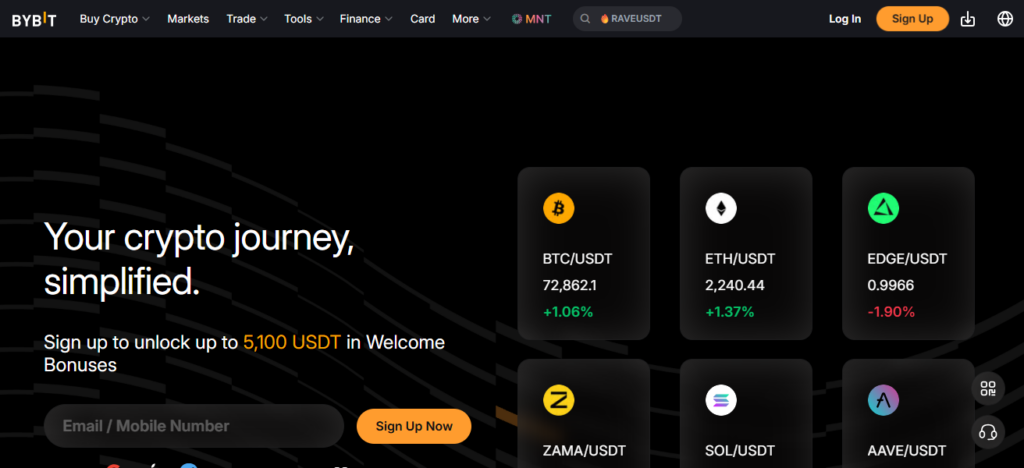
For derivatives trading with leverage up to 100x and advanced trading tools, Bybit is best known. By 2026, it is one of the leading exchanges in the world accounting for nearly 8% market share with rapid growth through contract trading. P
Erhaps, what stands out the most is its quick recovery following the $1.5 billion 2025 hack – over the course of days, user funds were returned showcasing resilience, liquidity strength and institutional backing.
Bybit
Pros:
- Offers high liquidity and advanced derivatives trading with leverage up to 100x globally.
- Fast execution speed with strong infrastructure suitable for professional and institutional traders.
- Wide range of crypto assets including major coins and trending altcoins available.
- User-friendly interface with copy trading, bots, and multiple earning opportunities integrated.
Cons:
- Limited features without KYC, including withdrawal restrictions and reduced account limits.
- Not officially regulated in India, creating uncertainty for long-term legal usage.
- Past security incidents may concern risk-averse users despite recovery efforts.
- Complex tools may be overwhelming for beginners entering crypto trading initially.
2. MEXC
Founded in 2018, MEXC has emerged as a leading global trading platform for cryptocurrency assets.
It also supports more than 1,500 cryptocurrencies, including many altcoins and DeFi tokens. It is popular for low trading costs, regular token listings, and futures.
MEXC has around 7.8% of the market share as of 2026, making it one of the best exchange globally.
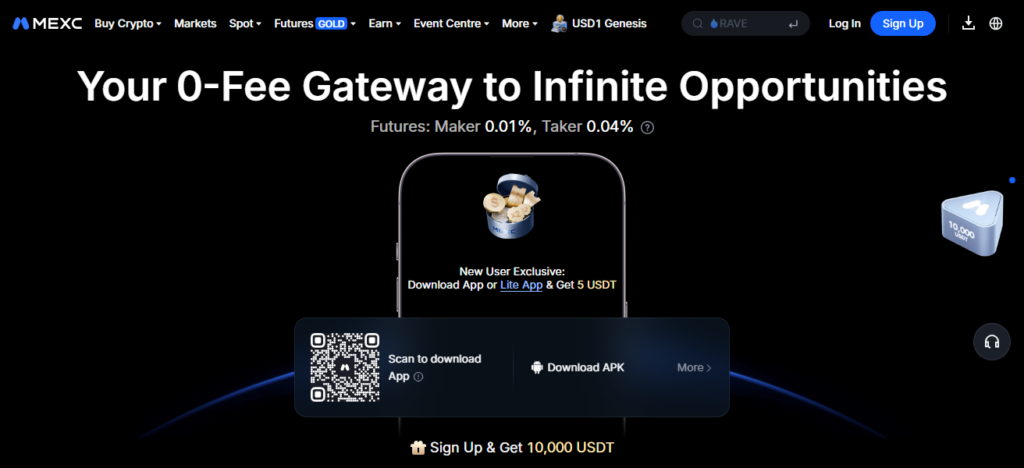
Its real strength is getting listings of new tokens faster than other platforms do, so early investors can get in.
Furthermore, MEXC is an all-in-one platform with the option to stake coins, copy trade and take advantage of its launchpad
for both newcomers looking to get started and advanced users searching for early-stage opportunities.
MEXC
Pros:
- Supports over 1,500 cryptocurrencies, ideal for discovering new and early-stage tokens quickly.
- Very low trading fees and frequent promotions for active traders globally.
- Allows trading without mandatory KYC for basic usage and withdrawals.
- Offers futures, staking, launchpad, and copy trading for diversified earning strategies.
Cons:
- Lower regulatory clarity may raise compliance concerns for Indian users.
- Interface can feel cluttered due to too many features and token listings.
- Liquidity varies across smaller altcoins, increasing slippage risks.
- Customer support response times can be inconsistent during high traffic periods.
3. CoinEx
Founded in 2017, CoinEx is a worldwide digital currency exchange that supports hundreds of coins including Bitcoin (BTC), Ethereum (ETH) and altcoins.
There’s also nothing worse than a complex interface when you’re getting started, yet it doesn’t mean that you can’t have advanced trading available.
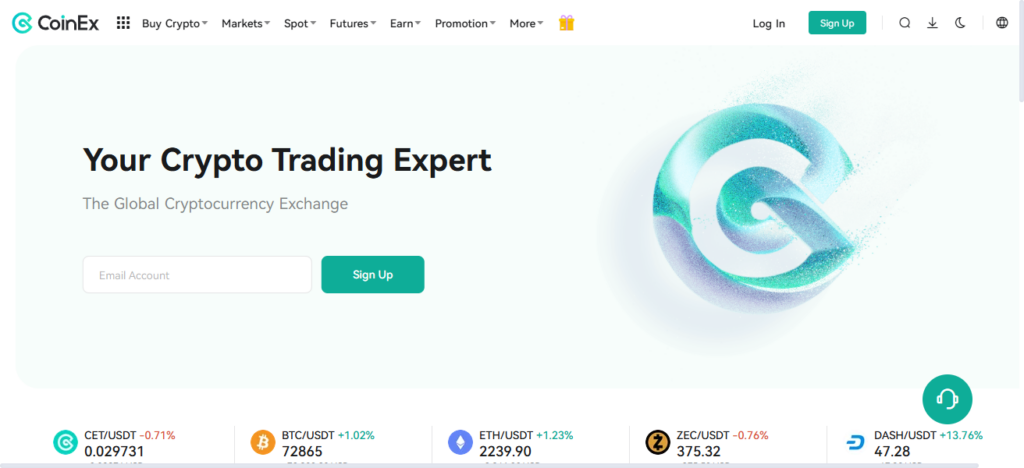
CoinEx is a spot, margin, futures trading, and staking service. Its native CET token wallet offers discounts on trading fees and other ecosystem advantages.
With multi-layer protection systems, the platform emphasizes stability and security. Aiming to Make It Easier for Everyone: CoinEx’s Globalization Strategy
CoinEx
Pros:
- Simple and beginner-friendly interface with smooth navigation and easy trading experience.
- Supports a wide variety of cryptocurrencies with stable platform performance.
- Offers spot, margin, futures, and staking options in one ecosystem.
- Provides fee discounts through CET token, improving trading cost efficiency.
Cons:
- Limited advanced trading tools compared to larger exchanges like Bybit or KuCoin.
- Lower popularity results in less liquidity for some trading pairs.
- Fewer promotional campaigns and rewards compared to competitors.
- Partial KYC limits may restrict withdrawals and advanced features.
4. KuCoin
KuCoin opened in 2017 and has established itself as the “People’s Exchange” for its comprehensive list of altcoins.
The platform offers spot, margin, futures and staking services for more than 700 cryptocurrencies.
KuCoin is also known for listing promising projects early, making it a choice of trading platforms for traders going into high-growth tokens.

Some of its key features are automated trading bots, copy trading and passive income products.
By 2026, KuCoin continues to be one of the leading platforms for altcoin discovery and retail trading innovation.
The exchange combines the convenience of centralized exchanges with decentralized-style access to emerging tokens and advanced trading tools.
KuCoin
Pros:
- Huge selection of altcoins, making it ideal for early investment opportunities.
- Advanced features like trading bots, margin trading, and passive income products.
- Allows limited trading without KYC for basic users globally.
- Strong community reputation and consistent innovation in retail trading tools.
Cons:
- Regulatory uncertainty in several countries, including India, may impact accessibility.
- Past security breach (2020) still affects trust for some cautious users.
- Interface can be complex for beginners due to many features.
- Withdrawal limits are restricted for non-KYC accounts.
5. TradeOgre
TradeOgre: TradeOgre is a niche cryptocurrency exchange based around privacy coins like Monero and some lesser-known altcoins, often launched in 2018.
It supports a smaller selection of cryptocurrencies, but offers anonymous trades and doesn’t require extensive user verification.
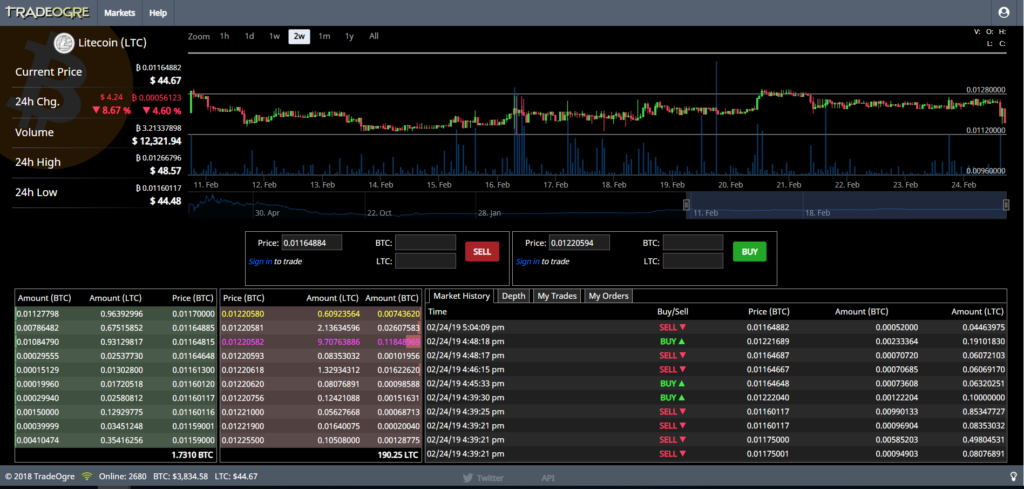
TradeOgre is a favorite for those who value their privacy and censorship resistance. Its interface is basic and it doesn’t offer advanced tools like many major exchanges, but that simplicity attracts its key demographic.
What’s more unique is its no-KYC so you can trade without KYC. But, it has lower liquidity than larger exchanges which makes it more suited to particular trading requirements.
TradeOgre
Pros:
- Strong focus on privacy coins like Monero and anonymous trading experience.
- No KYC requirement, making it attractive for privacy-focused users.
- Simple and lightweight interface for quick trades without complications.
- Supports niche and rare cryptocurrencies not available on major exchanges.
Cons:
- Very low liquidity compared to mainstream exchanges, causing price volatility.
- Limited number of supported coins and trading pairs.
- No advanced trading tools, charts, or professional features available.
- Lack of transparency and customer support raises potential trust concerns.
6. XT.com
XT. com is a global cryptocurrency exchange that provides spot, margin, futures, and derivatives trading services founded in 2018.
It has support for hundreds of cryptocurrencies, including popular and newly launched tokens. XT. com is built to create a better user experience with diverse trading pairs.
The platform also has unique features such as social trading, staking services, and NFT marketplace integration.
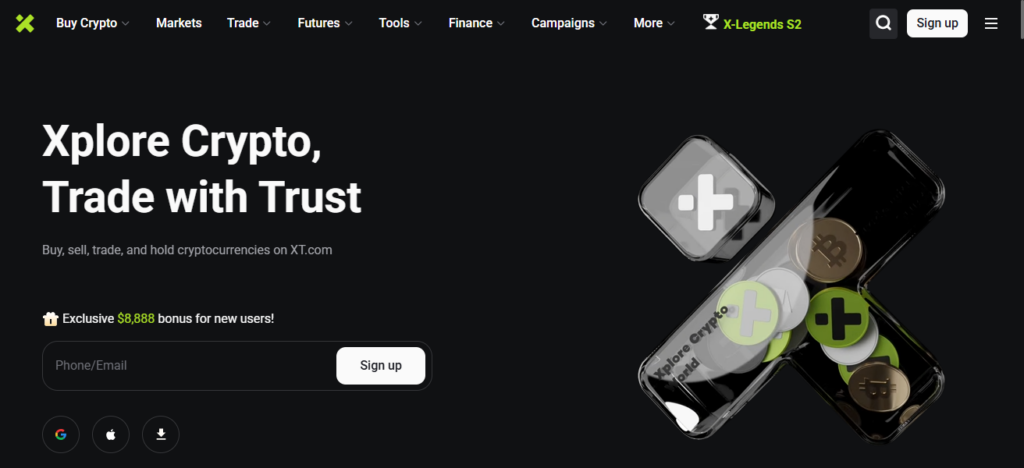
The platform has aggressively expanded in emerging markets and supports other languages.
XT. Its rapid listing of new tokens, marketing campaigns, and international reach make com even more attractive to traders searching for diverse opportunities.
XT.com
Pros:
- Offers diverse services including spot, futures, staking, and NFT marketplace.
- Supports a large number of cryptocurrencies including newly listed tokens.
- Provides social trading features for beginners to copy experienced traders.
- Allows limited access without KYC for basic trading functions.
Cons:
- Lower trust score compared to top-tier exchanges in global rankings.
- Liquidity issues in smaller tokens may affect trading efficiency.
- Interface may feel complex due to feature-heavy ecosystem.
- Regulatory clarity and compliance remain uncertain for Indian users.
7. Uniswap
Uniswap, one of the largest decentralized exchanges (DEX), was created in 2018 and runs on the Ethereum blockchain.
It supports thousands of ERC-20 tokens and uses automated market maker (AMM) technology rather than order books.
Users can directly swap tokens from their wallets without intermediaries. One of the most innovative features is liquidity pools
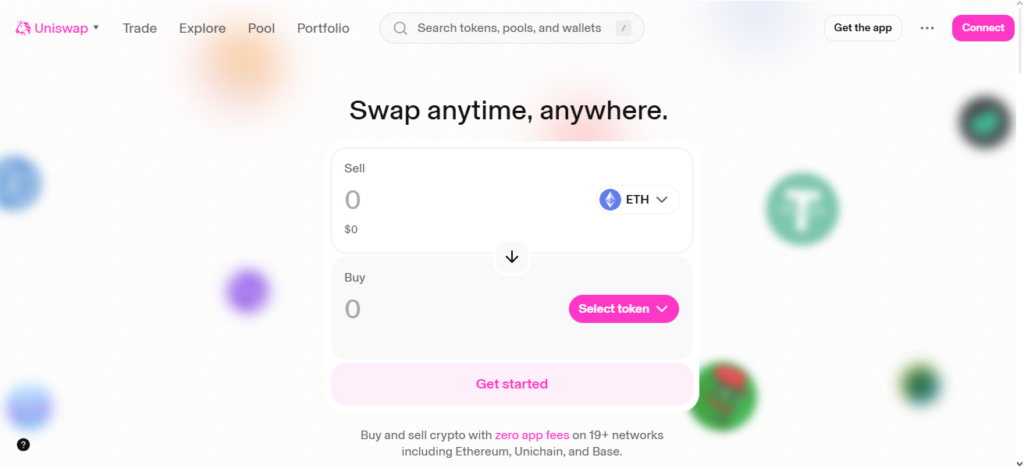
which enable users to provide liquidity and earn fees. UNISWAP Governance token ( UNI ) allows Decentralized decision-making.
It is still a leader in DeFi with billions of total value locked. As a permissionless platform that facilitates trading of various assets using smart contracts, it serves as a cornerstone of decentralized finance ecosystems.
Uniswap
Pros:
- Fully decentralized exchange with no KYC, ensuring complete user privacy and control.
- Supports thousands of ERC-20 tokens with permissionless listing system.
- Users retain custody of funds through wallet-based trading.
- Liquidity pools allow users to earn passive income via fees.
Cons:
- High gas fees on Ethereum network can make small trades expensive.
- No customer support since it operates via smart contracts.
- Vulnerable to impermanent loss for liquidity providers.
- Requires technical knowledge to use wallets and manage transactions safely.
8. PancakeSwap
Launch of PancakeSwap in 2020, it’s the leading decentralized exchanges available on the BNB Chain with low fees and fast transactions.
It is compatible with BEP-20 tokens and provides services such as token swapping, staking, yield farming, and lottery features.
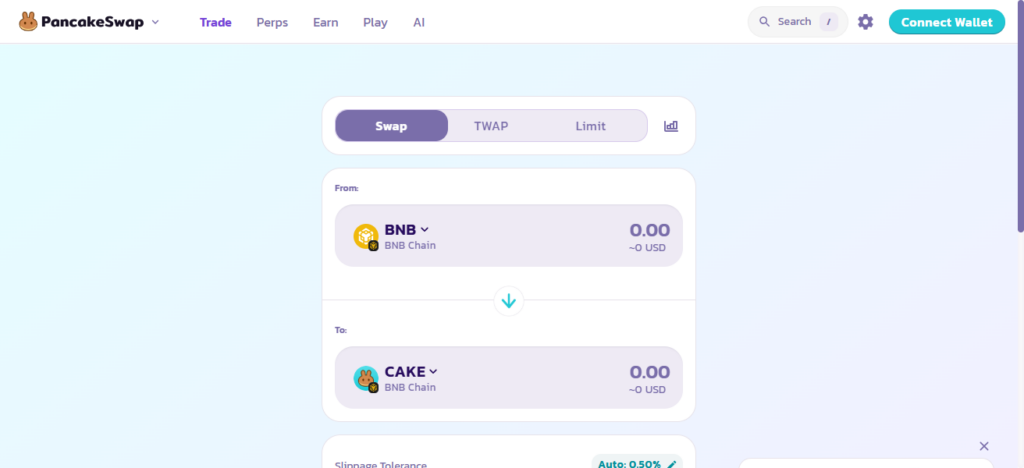
PancakeSwap has been a known nomenclature for retail users the alternative that makes it cheaper than platforms based on Ethereum.
Its native token, CAKE, serves for governance and rewards. Unique features include gamified DeFi elements like prediction markets and NFTs.
With continued expansion through multi-chain solutions, PancakeSwap is sought after for affordable and fast decentralized trading.
PancakeSwap
Pros:
- Low transaction fees due to Binance Smart Chain network efficiency.
- Fast transaction speeds compared to Ethereum-based decentralized exchanges.
- Offers staking, farming, and gamified features like lotteries and NFTs.
- No KYC required, ensuring privacy and accessibility for global users.
Cons:
- Limited to BNB Chain tokens, reducing exposure to Ethereum ecosystem assets.
- Smart contract risks and potential vulnerabilities in DeFi protocols.
- Impermanent loss risks for liquidity providers.
- Requires crypto wallet knowledge, not beginner-friendly for new users.
9. Bisq
Finally.we have Bisq (formerly known as Bitsquare) which is a completely decentralized peer to peer bitcoin exchange launched in 2014.
Crypto enables users to buy and sell Bitcoin without a centralized authority, including fiat currencies and other crypto.
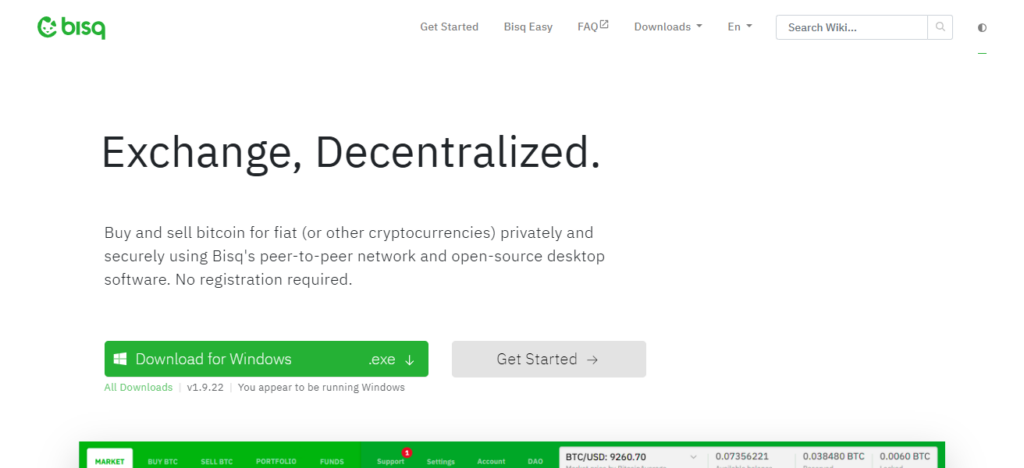
Bisq operates bajo the principles of privacy, security and censorship resistance, without the need for KYC. Trades are protected with multi-sig escrow and collateral deposits.
The service is an open-source platform that runs over the Tor network for better anonymity. Its governance model, where BSQ tokens are awarded to contributors
This is a key differentiator. Bisq best serves users who value decentralization and privacy more than speed and liquidity.
Bisq
Pros:
- Fully decentralized peer-to-peer exchange with strong privacy and no KYC requirements.
- Uses Tor network for enhanced anonymity and censorship resistance globally.
- Open-source platform with transparent governance and community trust.
- Supports fiat-to-Bitcoin trading without intermediaries or custodial risk.
Cons:
- Low liquidity and slower trade execution compared to centralized exchanges.
- Complex setup process, not suitable for beginners.
- Limited cryptocurrency support, mainly focused on Bitcoin trading.
- Requires security deposits, which may discourage small traders.
10. HodlHodl
HodlHodl started in 2018 as a non-custodial peer-to-peer Bitcoin exchange. By utilizing multi-signature escrow contracts, the service allows users weapons with trade without it ever leaving their hands.
therefore enhances privacy, as it does not hold user funds or require KYC verification unlike centralized exchanges.
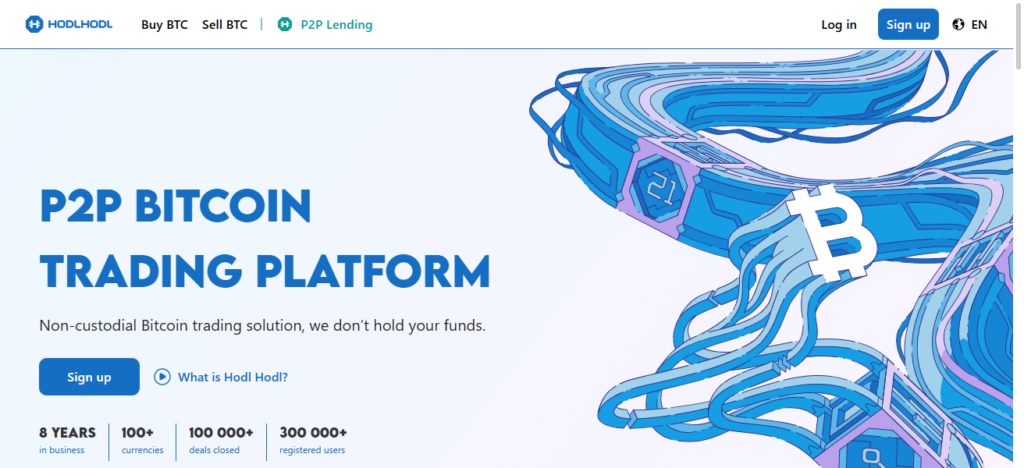
Its global lending platform is a distinguishing feature, enabling users to earn interest on Bitcoin.
The platform unites buyers and sellers directly, this is what it does all over the world. HodlHodl is appreciated for its transparency, security model, and focus on decentralization in the ever-growing domain of peer-to-peer crypto trading.
HodlHodl
Pros:
- Non-custodial platform ensuring users always control their funds securely.
- No KYC requirement, supporting privacy-focused peer-to-peer Bitcoin trading.
- Multi-signature escrow system enhances security during transactions.
- Offers Bitcoin lending services for earning passive income globally.
Cons:
- Limited to Bitcoin trading, lacking support for multiple cryptocurrencies.
- Lower liquidity compared to centralized exchanges.
- Trade matching may take longer due to peer-to-peer nature.
- User experience depends heavily on counterparty reliability and trust.
Is it legal to use no-KYC crypto exchanges in India?
While it is not explicitly illegal to use no-KYC crypto exchanges in India, it falls under a regulatory gray area.
Registered platforms will also have to ensure compliance with guidelines issued by the Reserve Bank of India and Financial Intelligence Unit – India, especially anti-money laundering rules.
But many offshore exchanges have lax KYC enforcement. While Indian users can use them, they have to report crypto gains for tax purposes.
As regulations are still evolving, utilizing no-KYC exchanges pose legislation and compliance risks, thus more than using proper documentation of identity, users should alongside be aware of the government policies.
Is Bybit safe to use in India without KYC verification?
Bybit is available and safe to use in India without KYC, but not completely safe. This allows users to trade and withdraw small amounts (up to around 20,000 USDT per day) without any verification.
Yet, most essential features such as fiat deposits, higher limits and full account access are only available upon KYC.
The platform may also request identity verification during withdrawals and checks for unusual activity
Which can temporarily limit funds. In general terms, this is pretty safe for smaller amounts of money but mandated KYC means better security and long-term stability of your account.
Conclusion
Summary Best Crypto Exchange without KYC in India Exchanges such as Bybit, MEXC and Uniswap offer flexibility with less stringent verification processes.
But they come with risks including withdrawal limits and regulatory uncertainty. Selecting a reputable platform and controlling risks are necessary for your safe trading adventure!
FAQ
No-KYC crypto exchanges allow users to trade cryptocurrencies without submitting identity verification documents.
They are not illegal but operate in a regulatory gray area under evolving Indian crypto laws.
Popular options include Bybit, MEXC, KuCoin, CoinEx, and decentralized platforms like Uniswap.
Yes, but most exchanges impose daily withdrawal limits on non-verified accounts.

