



In this article, I will discuss the Best Crypto SaaS Platforms for Startups, focusing on blockchain networks that enable scalable, secure, and cost-efficient software solutions.
These platforms empower startups to build decentralized applications, integrate smart contracts, and streamline Web3 services while reducing development complexity, infrastructure costs, and time-to-market in today’s rapidly evolving crypto ecosystem.
Key Points & Best Crypto SaaS Platforms for Startups
Ethereum – Smart contract leader, massive developer ecosystem.
Solana – Ultra-fast transactions, low fees for scalable apps.
Polygon – Layer-2 scaling, great for affordable dApps.
Binance Smart Chain (BSC) – High adoption, strong DeFi ecosystem.
Hyperledger Fabric – Enterprise-grade, modular blockchain framework.
Avalanche – High throughput, customizable subnets for startups.
Algorand – Pure proof-of-stake, eco-friendly and secure.
Cardano – Research-driven, strong focus on sustainability.
Cosmos – Interoperability hub, connects multiple blockchains.
Near Protocol – Developer-friendly, sharding for scalability.
10 Best Crypto SaaS Platforms for Startups
1. Ethereum
Ethereum was among the first companies to utilize smart contracts and is still highly regarded as a blockchain for numerous dApps.
Developers are able to use the blockchain and the tools associated with it to quickly build prototype projects and utilize them on a production scale.
Ethereum is a good option for digital tokenization as well as projects in decentralized finance and NFTs. Unfortunately, the blockchain does present a few challenges as well.

Ethereum has a lot of network traffic, which results in a greater cost for users and it has a greater risk for smaller projects.
The innovation in Ethereum 2.0, which is being released, will improve the blockchain’s network efficiency and energy usage as it switches to a functionality named proof of stake.
The blockchain can be integrated with lots of different digital wallets and DeFi programs. Therefore, allowing people to use Ethereum’s blockchain for a project will improve a startups chance of success.
Ethereum – Key Features
- Smart Contract Pioneer: Thanks to Ethereum, we had the first programmable smart contracts that allowed users to create highly sophisticated decentralized applications from multiple sectors including DeFi, NFTs, DAOs, and Gaming.
- Massive Developer Ecosystem: Ethereum also features the most extensive community of developers and the most advanced tool in the space, including Solidarity, Truffle, and Hardhat, and covering documentation.
- High Security \& Decentralization: With thousands of validators securing ethereum network, it is extremelty trusted and censorship resistant.
- Layer-2 Scalability Support: Ethereum works well with Layer-2 like Arbitrum, Optimism, and Polygons to reduce fees and improve speed.
| Pros | Cons |
|---|---|
| Largest smart contract ecosystem and developer community | High gas fees during network congestion |
| Mature tooling, libraries, and documentation | Scalability limitations on Layer-1 |
| Strong DeFi, NFT, and DAO adoption | Slower transaction speeds |
| High security and decentralization | Not beginner-friendly for small budgets |
| Broad wallet and exchange compatibility | Requires Layer-2 solutions for efficiency |
2. Solana
On the contrary, Solana is a highly specialized blockchain built for speed and efficiency. With a very rare low-latency transaction speed, Solana is a great blockchain for start-ups.
With Proof of History (PoH), Solana is able to process thousands of transactions for very low fees, making it a great blockchain for DeFi, NFT or gaming projects.
On top of that, Solana has a very supportive developer community, quick plug and play deployment via there advanced SDKs and other integration developer tools.
Solana’s decentralized network supports a plethora of use-cases, from decentralized exchanges to applications that are built on top of it (Web3 applications).
Even when there is very infrequent network downtime, Solana’s efficient and cost-effective blockchain is one of the best options for start-ups and small businesses looking to optimize for a high volume, low cost, microtransaction model
High volume microtransaction use cases with a polished user experience are very plausible and operational cost are kept to a minimum.
Solana – Key Features
- High-Speed Transactions: Solana is preferable in situations like gaming and trading as it can process thousands of transactions in a second.
- Low Transaction Fees: For microtransactions, the costs always remain low, even at times of high network activities.
- Proof of History (PoH): A unique consensus mechanism that enhances ordering of transactions and improves network efficiency.
- Growing Web3 Ecosystem: NFTs, DeFi, and Web 3 applications have a strong and growing community and developer ecosystem with appropriate and extensive toolkits (SDK).
| Pros | Cons |
|---|---|
| Extremely fast transaction speeds | History of network outages |
| Very low transaction fees | Higher hardware requirements for validators |
| Ideal for gaming and high-volume apps | Less decentralized than Ethereum |
| Strong NFT and DeFi ecosystem | Smaller developer base compared to Ethereum |
| Innovative Proof of History consensus | Ecosystem still maturing |
3. Polygon
Polygon was previously Matic network and is an EtheAeron Layer-2 scaling solution with faster transactions, lower fees, and stellar securrity. dApps are cost-effective as gas is relatively cheap with polygon.
Micro transactions, gaming and Defi are ideal with polygon. Polegon sdk enhances modularity and independent chains and rollups.
Polygon has an extensive ecosystem with high scalability. Low fees and speed, especially with Ethereum compatible scaling. Especially good for starters.
Polygon Key Features
- Polygon Ethereum Layer-2 Scaling Tier 1 Polygon Ethereum layer 2 modifies the Ethereum Mainnet by enabling quicker transactions and a reduced gas fee.
- EVM Compatible Deploying smart contracts on Ethereum is possible for developers through a simple coding transposition.
- Chain Scaling Solutions Supports multiple solutions like PoS chains, zk-rollups, optimistic rollups, and application-specific chains.
- Strong Enterprise Adoption Implemented by worldwide enterprises and Web 2.0 corporates.
| Pros | Cons |
|---|---|
| Low transaction costs | Relies on Ethereum for security |
| High compatibility with Ethereum dApps | Layer-2 complexity for beginners |
| Strong enterprise and brand partnerships | Bridge risks between chains |
| Fast confirmation times | Network congestion during peak usage |
| Flexible scaling solutions (zk, PoS, rollups) | Limited independence as a standalone chain |
4. Binance Smart Chain (BSC)
Compatible Blockchains, EVM-Compatible, and High Transaction Volume. Binance Smart Chain (BSC) is one of the fastest, and is a low-cost, low-transaction fee blockchain.
Since the majority of the dApps in the ecosystem (e.g. DeFi and gaming, NFT marketplaces, etc.) are integrated in the smart-contracts, the transaction fees are low, and the dApps are growing, ecosystem is appreciated by the innovators in the DeFi and dGaming space.
Binance (BSC) Exchange operates fast and provides immediate liquidity, low-cost. Binance’s (BSC) dApps security, transp) good programmable (dApps) multifunctional, extensible
low-complex-ness, and fast performable, and more) features that blockchain as a service (BaaS) systems offer make it an IDEAL system for expanding and rapidly growing in the market.
Binance Smart Chain BSC Key Features
- Low Fees and Fast Blocks Allows instant approvals and minimal costs per transactions which is beneficial for applications with high transactions.
- EVM Compatible. Improves the transition for projects and developers without complications.
- Binance Ecosystem Support Provides direct access to a high-volume liquid Binance exchange and a multitude of users.
- Decentralized Finance Focused Infrastructure Promotes the yield farming and supports the DEX and NFT marketplaces.
| Pros | Cons |
|---|---|
| Very low fees and fast transactions | More centralized validator structure |
| EVM-compatible and easy migration | Higher risk of scam projects |
| Backed by Binance liquidity and users | Security concerns from rapid growth |
| Strong DeFi adoption | Less decentralized governance |
| Beginner-friendly ecosystem | Regulatory dependency on Binance |
5. Hyperledger Fabric
Hyperledger Fabric is useful for enterprise startups that want privacy, security, and modularity, due to it being a permissioned blockchain framework.
Fabric is good for the supply chain, healthcare, finance, and B2B, for it has more controlled access in comparison to the public blockchains.
As a result of the pluggable architecture, startups enjoy the ability to customize the consensus protocols, identity access management, and chaincode.
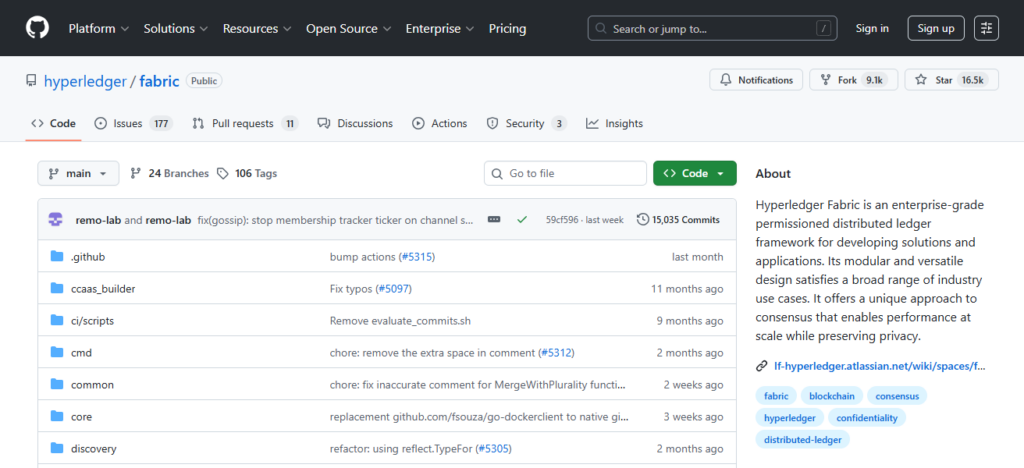
Fabric allows for private channels and allows for confidential transactions to occur between some participants. It has some scalability and interoperability, so it is good at supporting complicated enterprise workflows.
Hyperledger Fabric also has good and detailed documentation and strong community support. If a startup needs to work in an industry that is regulated, it will have a strong secure enterprise blockchain that it can innovate on.
Hyperledger Fabric Key Features
- Permissioned Block Chain Network Provides access control which is beneficial to enterprises and permissible industries.
- Modular Architecture Tailored consensus, identity management and data siloing/ privacy controls.
- Private Channels Supports selective confidentiality in transactions.
- Enterprise Grade Security Intended for high reliability, compliance, and stable operation.
| Pros | Cons |
|---|---|
| High privacy and permissioned access | Not suitable for public dApps |
| Enterprise-grade security | No native cryptocurrency incentives |
| Customizable architecture | Complex setup and maintenance |
| Ideal for regulated industries | Limited open ecosystem |
| Backed by Linux Foundation | Requires technical expertise |
6. Avalanche
Avalanche offers the most performant interoperability solutions with its unique architecture built for enterprise interoperability with low-cost, customizable, and ultra-fast blockchains.
Startups can build tailored blockchains, and lay out optimized architectures for their applications, to leverage Avalanche’s subnets.
Avalanche’s consensus algorithm processes thousands of transactions in seconds with near-instant finality.
Its Ethereum Virtual Machine (EVM) compatibility and low transaction costs are the main reasons for its adoption in different tiers of the DeFi, NFT, and enterprise blockchain sectors.
With the growing interest in Avalanche, its emphasis on developer experience, and its focus on enterprise interoperability with customizable infrastructures, it is a go-to for most new ventures in the space.
Avalanche Key Features
- High-Throughput and Low Latency Near instant finality and large transactional capacity.
- Custom Subnets: It is possible for startups to establish blockchains with particular purposes with unique guidelines.
- EVM Compatibility: It is possible to easily launch applications based on Ethereum.
- Low Transaction Costs: Transaction fees are low enough to be utilized for Defi, NFTs, and use cases within big enterprises.
| Pros | Cons |
|---|---|
| Near-instant transaction finality | Smaller ecosystem than Ethereum |
| Custom subnets for app-specific chains | Learning curve for subnet deployment |
| Low fees and high throughput | Validator requirements can be costly |
| EVM compatibility | Less brand recognition among users |
| Strong DeFi growth | Tooling still evolving |
7. Algorand
Algorand is a high-throughput, permissionless blockchain with leading technology in scalability, security, and decentralization.
Startups in need of rapid transaction finality for the blockchain may leverage financial applications, dApps, and tokenization on the platform.
The Pure Proof of Stake (PPoS) algorithm is also energy efficient and eco-friendly while having low confirmation times and transaction costs.
Algorand has strong developer support with tools like SDKs in various languages, cryptocurrencies and smart contracts for atomic transfers.
Startups looking for DeFi solutions, enterprise applications, or cross-border payment systems will find the platform’s high interoperability, stability and low costs appealing. Trusted for speed and reliability, Algorand allows startups to scale without high risks.
Algorand – Key Features
- Pure Proof of Stake (PPoS): Achieves quick finality while being decentralized and eco-friendly.
- Low Fees & Fast Confirmations: Useful for applications based on finance and payments.
- Developer-Friendly SDKs: Easy to use smart contracts alongside with support for more than one programming language.
- High Network Stability: Performs consistently, with no forking and no performance degradation, even under high loads.
| Pros | Cons |
|---|---|
| Fast and deterministic finality | Smaller DeFi and NFT ecosystem |
| Energy-efficient consensus | Limited developer adoption |
| Low transaction fees | Less marketing visibility |
| Strong focus on financial use cases | Fewer third-party tools |
| High security and stability | Slower ecosystem growth |
8. Cardano
Cardano is a unique multi-layered blockchain with a focus on sustainability and security and is more advanced than most competitors. Startups benefit because it separates smart contract functions from transaction settlement. Being more flexible and performant.
Its Proof of Stake (Ouroboros) consensus is more decentralized and energy efficient than others. Plutus is its dApp development platform with smart contracts. It is slower growing than Ethereum and thus has a lot of star DeFi, identity, and supply chain management.
The projects on Cardano are very reliable because of the rigorous approach to academics. There are a number of ongoing partnerships. Most blockchains for DeFi and supply chain applications are not reliable and stable and have a high environmental cost.
Cardano – Key Features
- Research-Driven Design: Prepared by using research that is peer-reviewed and scholarly, contributing to the design’s longevity.
- Ouroboros Proof of Stake: Consensus mechanism with high security and low energy usage.
- Layered Architecture: Provides room for more options by separating the layers for settlement and computation.
- Secure Smart Contracts: Used by Plutus for formal verification that results in fewer weaknesses.
| Pros | Cons |
|---|---|
| Research-driven and highly secure | Slower development pace |
| Energy-efficient Proof of Stake | Smaller dApp ecosystem |
| Strong focus on sustainability | Complex smart contract language (Plutus) |
| Layered architecture improves stability | Fewer live DeFi projects |
| Long-term scalability vision | Lower short-term flexibility |
9. Cosmos
Cosmos is designed for interchangeability and expandable functionality as a model blockchain ecosystem.
Startups can link numerous blockchains and transfer assets and data fluidly via the Inter-Blockchain Communication (IBC) protocol.
Thanks to a Tendermint-based Proof of Stake consensus, transactions finalize quickly and cost little energy.
Custom blockchains to be tailored for specific applications like DeFi to gaming and more can be built by startups using the Cosmos SDK.

An ecosystem of interlaced dApps that are scalable can be built, for developers who do not want to rely on a single chain.
Extensibility, modularity, and developer-friendly tooling are given to startups. Multi-chain strategies can be easily integrated Cosmos, unlocking the ability to work with a variety of blockchains.
Cosmos – Key Features
- Interoperability via IBC: Supports blockchains that are independent of one another to communicate with one another.
- Cosmos SDK: Developers are able to create tailored blockchains to meet specific requirements.
- Fast Finality: For efficient and speedy transactions, the Tendermint consensus is used.
- Scalable Multi-Chain Ecosystem: This is suitable for new businesses that are developing applications that span multiple blockchains.
| Pros | Cons |
|---|---|
| Excellent interoperability via IBC | Requires managing separate chains |
| Highly customizable blockchains | Less suitable for simple dApps |
| Fast and efficient consensus | Fragmented ecosystem |
| Ideal for multi-chain startups | Security varies by chain |
| Strong developer SDK | Steeper learning curve |
10. Near Protocol
Near Protocol is a blockchain that is user-friendly and low-cost. They have a unique structure that helps keep their transaction times quick.
This is also how they keep their transaction costs low. Startups can use the simple developer tools.
This makes it easy for new companies to use their resources. NEAR has tools for user experience to make the transition easy for new user. They have low costs for their applications and support for DeFi and NFT.
Their ecosystem is improved with new tools for collaboration to enhance new opportunities. Companies can build applications without needing a complex structure.
Near Protocol Key features
- Sharding Architecture (Nightshade): Provides great scalability while still ensuring high performance.
- User-Friendly Accounts: Readable account names are helpful in getting new users onboard.
- Low Fees & Fast Transactions: Startups and consumer applications expenditures are lower.
- Developer-Centric Tools: Provides full support for Rust and AssemblyScript, along with streamlined deployment processes.
| Pros | Cons |
|---|---|
| User-friendly account model | Smaller ecosystem than major chains |
| Low fees and high scalability | Lower liquidity compared to Ethereum |
| Sharding improves performance | Limited enterprise adoption |
| Strong developer onboarding | Fewer mature DeFi protocols |
| Focus on Web2-to-Web3 usability | Ecosystem still growing |
Conclsuion
To wrap is up, the Most Worthwhile Crypto SaaS Platforms for Startups offer flexible, safe, and user-friendly blockchain foundations for building cutting-edge Web3 applications.
By strategically selecting the most appropriate platform depending on expenses, efficiency, and ecosystem assistance, companies can quicken the development process and operational challenges, and sustainable growth in the emerging world of crypto along with SaaS services.
FAQ
Crypto SaaS platforms provide blockchain-based infrastructure and tools that help startups build, deploy, and scale Web3 applications without managing complex backend systems.
They reduce development time, lower costs, improve security, and offer ready-made blockchain integrations for faster product launches.
Ethereum, Polygon, Solana, and BSC are popular choices due to strong ecosystems, scalability, and developer support.
Yes, many platforms offer SDKs, APIs, documentation, and no-code or low-code tools for easier onboarding.
Most platforms support smart contracts, enabling automation, tokenization, and decentralized business logic.

