


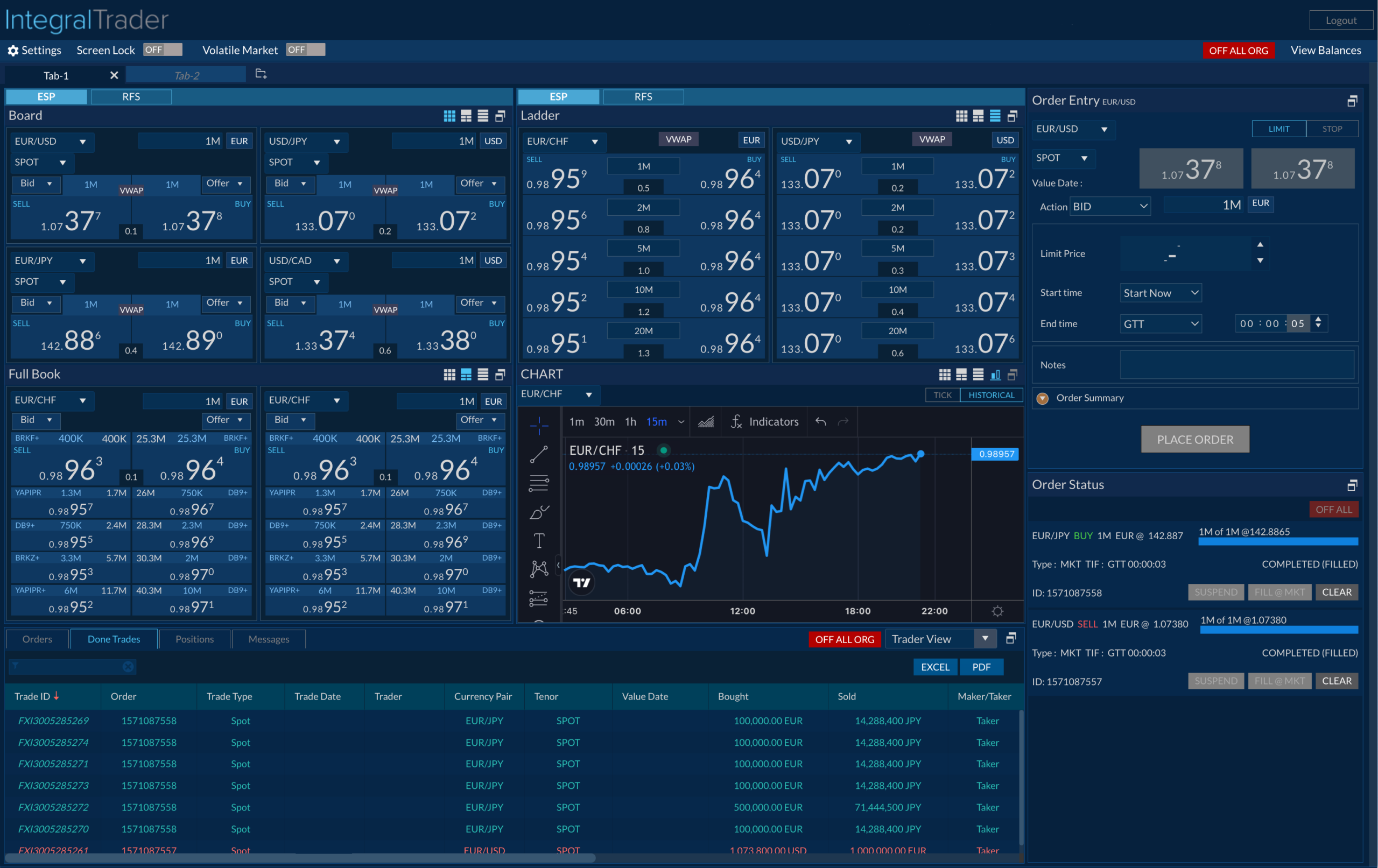
In this article, I discuss the top Market Data Providers that supply reliable, up-to-the-minute, and past financial data for the Investing, Trading, and Business communities.
These services provide critical market data and analytics and pricing with tools for effective engagement. From business and institutional solutions to API services, I cover the top innovative business data financial intelligence services.
What Are Market Data Providers?
Market Data Providers collect, organize, and report financial information internationally across all markets. They provide historical and real-time data on stock prices, forex, crypto, commodities, data points, and company research.
Services are consumed by traders, investors, institutions, and developers. Services are used to analyze and interpret data in order to mitigate and manage analysis. Modern market data providers offer APIs and analytics, but to an even greater extent AI built solutions to offset the lag in financial analysis.
Why Market Data Providers Are Important?
- Enhanced Investment Decisions: These providers give accurate information, allowing traders to discover possibilities and understand their choices.
- Improved Market Analysis: Accurate data leads to a clear understanding of the market.
- Risk Management: These securities allow investors to discover risks and achieve the best performance in a portfolio.
- Automated Trading: Reliable data allows automated strategies and financial research.
Key Points & Best Market Data Providers
- Bloomberg Terminal – Provides institutional-grade financial data, analytics, news, and trading insights globally.
- Refinitiv Eikon – Delivers real-time market data, research tools, and investment analytics solutions.
- FactSet – Offers comprehensive financial information, portfolio analysis, and market intelligence services.
- S&P Global Market Intelligence – Provides trusted data, research, and risk analysis worldwide.
- Morningstar Direct – Supplies investment research, portfolio analytics, and asset management data.
- ICE Data Services – Delivers exchange data, pricing information, and financial analytics tools.
- CME Group DataMine – Provides futures, options, and derivatives market data solutions.
- Quandl (Nasdaq Data Link) – Offers alternative datasets, economic data, and financial insights.
- Alpha Vantage – Provides API-based stock, forex, and cryptocurrency market data.
- Tiingo – Delivers affordable financial market data, APIs, and investment research tools.
10 Best Market Data Providers
1. Bloomberg Terminal
Bloomberg Terminal is one of the most revered data collection services in the financial market. It offers a plethora of real-time data and analytical tools for stocks, fixed income, commodities, and other economic indicators and company data along with economic and financial news.
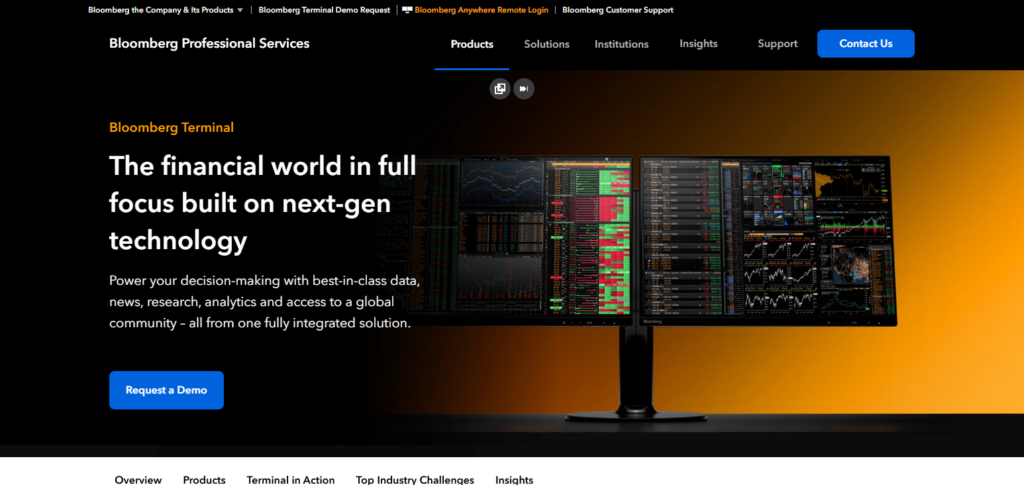
Bloomberg has plans to further augment predictive analytics and other features of Terminal that will allow consumers to automate large swathes of their workflows, and consequently, make decisions faster based on analytics in real-time for clients, traders, and large institutions in the financial market, throughout the world.
| Pros | Cons |
|---|---|
| Provides highly accurate real-time global financial market data. | Extremely expensive for individual users and small businesses. |
| Offers advanced analytics, research, and trading tools. | Requires training due to complex interface and features. |
| Includes extensive news, economic data, and company insights. | Subscription costs can be difficult for startups. |
| Trusted by banks, hedge funds, and institutions worldwide. | Limited accessibility compared with modern cloud platforms. |
| Supports AI-powered insights and workflow automation. | Not ideal for casual investors or beginners. |
2. Refinitiv Eikon
Refinitiv Eikon is one of the most reliable and cutting-edge platforms for real-time financial data, data analytics, and investment research. After its integration with London Stock Exchange Group (LSEG), the platform has lucrative offerings for its consumers in global equities, bonds, currencies, commodities, and economics.
Its AI-focused features, customizable dashboards, and risk analysis makes the platform an imperative tool for asset managers, bankers, and traders.
| Pros | Cons |
|---|---|
| Delivers comprehensive global market and financial datasets. | Premium pricing makes it expensive for smaller firms. |
| Provides strong research and risk management capabilities. | Interface may require professional training. |
| Offers powerful AI-driven search and analytics features. | Some features have additional licensing costs. |
| Covers equities, currencies, bonds, and commodities markets. | Data customization can be complex for new users. |
| Suitable for institutional investment professionals. | Less affordable than API-based alternatives. |
3. FactSet
FactSet houses financial market data along with analytics on portfolios and investments for institutional clients. The platform combines fundamental data on companies with research, data on market participation, and data on market equities and comes as one integrated solution.
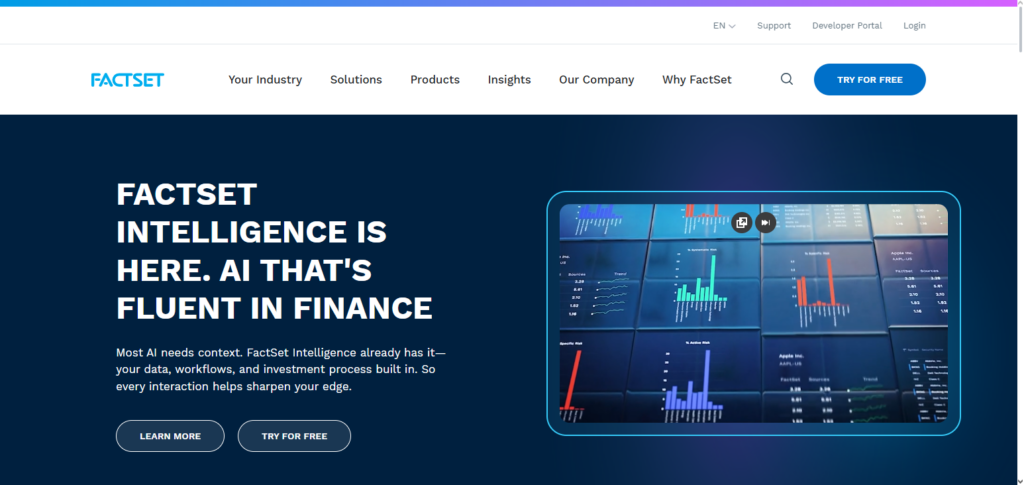
FactSet, with its intelligent analytics and cloud-based workflows, helps investment firms with opportunistic investing and portfolio maintenance, rated risk, and assessment, and the generation of financial statements.
| Pros | Cons |
|---|---|
| Combines financial data, analytics, and portfolio tools. | High subscription fees for professional users. |
| Provides detailed company research and ownership information. | Mainly designed for institutional investors. |
| Offers advanced portfolio monitoring capabilities. | Requires learning to use advanced features effectively. |
| Supports cloud-based financial workflows. | Limited free access options available. |
| Provides reliable investment intelligence solutions. | Smaller users may find it costly. |
4. S&P Global Market Intelligence
S&P Global Market Intelligence is one of the more trusted platforms for data in the financial markets with analytical and research offerings. Their platform covers analytics for equities and equity markets, commodities, company data, and analytics for credit and risk assessment.
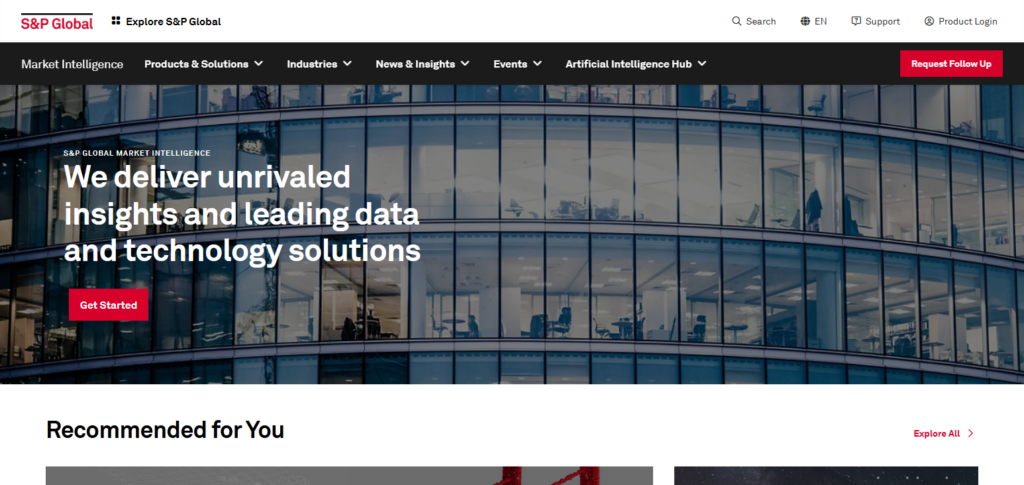
S&P’s analytic offerings are based on the latest machine learning algorithms. These analytics provide depth for the financial markets and help enterprises make investment decisions and assess risks.
| Pros | Cons |
|---|---|
| Provides trusted financial and industry research data. | Pricing is generally high for small companies. |
| Covers global markets, companies, and economic indicators. | Advanced tools may require professional expertise. |
| Offers powerful risk analysis and predictive insights. | Large datasets can be overwhelming for beginners. |
| Uses AI technology for deeper market analysis. | Custom solutions may increase overall expenses. |
| Trusted by financial institutions worldwide. | Not focused on retail investor needs. |
5. Morningstar Direct
Based on reviews, asset managers, advisors, and professionals in finance prefer using Morningstar Direct as their investment research tool. They offer analytics on portfolios, funds, and investments, as well as assessments of performance and risk.
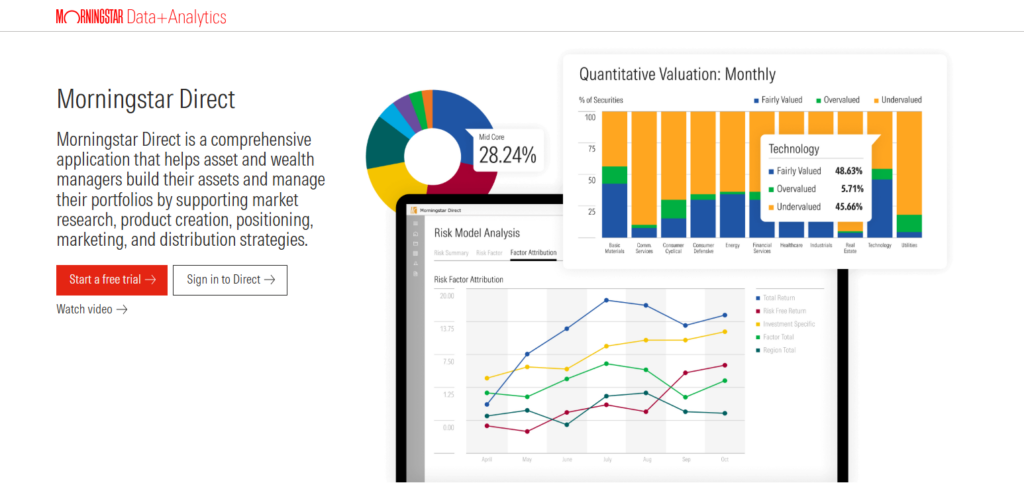
Due to their improved global reach and sophisticated analytics, users of Morningstar Direct are able to understand trends in the market and construct portfolio strategies supported by reliable data.
| Pros | Cons |
|---|---|
| Excellent investment research and portfolio analytics platform. | Primarily focused on investment management users. |
| Provides strong mutual fund and asset data coverage. | Subscription pricing may be expensive. |
| Offers reliable ratings and performance analysis. | Limited high-frequency trading data features. |
| Helps advisors create better investment strategies. | Less suitable for active traders. |
| Provides global investment insights and reports. | Advanced analytics require experience. |
6. ICE Data Services
As a part of the Intercontinental Exchange, ICE Data Services offers high quality data across financial markets. They cover exchange data, pricing of fixed income, and assessed data and risk services.
Their sophisticated infrastructure and tools of trade supported by real data allow banks and hedge funds to make better trading and investment decisions.
| Pros | Cons |
|---|---|
| Provides accurate exchange and pricing information. | Mainly targeted toward financial institutions. |
| Covers fixed income, commodities, and derivatives markets. | Pricing details are not always publicly available. |
| Offers reliable market infrastructure and technology. | May require technical expertise for integration. |
| Supports real-time financial risk management. | Less beginner-friendly compared with simple APIs. |
| Trusted by global banks and investment firms. | Custom data solutions can be expensive. |
7. CME Group DataMine
CME Group DataMine is one of the most comprehensive data services for historical and current market data. This service is intended for the analysis of derivatives, futures, options, interest rates, and even the commodities and cryptocurrency markets.
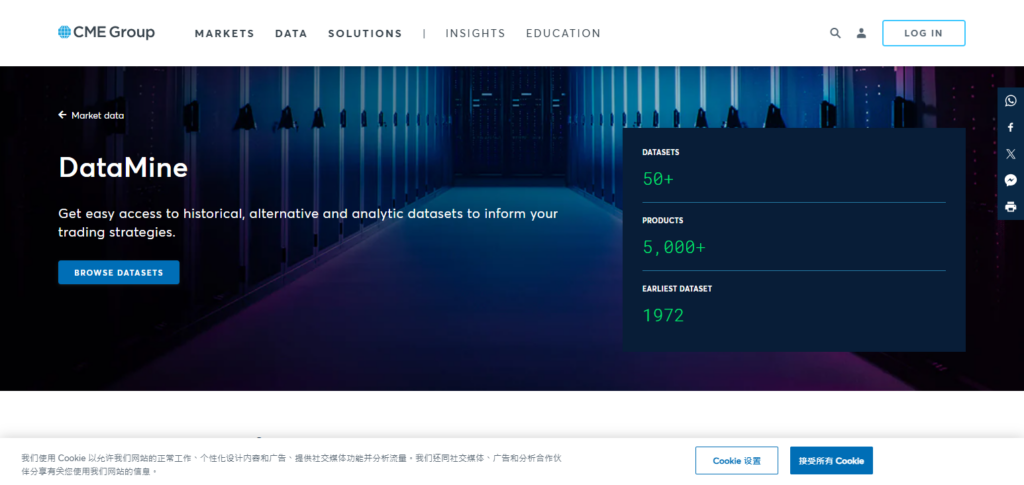
These datasets are frequently employed for the development, testing, and modeling of trading strategies and the risk associated with them. Because it is cloud based, this service can greatly improve the efficiency of market analysis.
| Pros | Cons |
|---|---|
| Provides extensive historical derivatives market datasets. | Mainly focused on CME-related markets. |
| Useful for backtesting and quantitative research. | Data access can become costly at scale. |
| Offers futures, options, and commodities information. | Requires analytical skills to use effectively. |
| Supports institutional trading strategy development. | Less suitable for general investors. |
| Provides high-quality exchange-generated data. | Limited coverage outside derivatives markets. |
8. Nasdaq Data Link (Quandl)
Nasdaq Data Link (formerly Quandl) is a very user friendly market data portal that provides financial and economic data as well as alternative data. This service is especially useful for the development of models and algorithms for automated trading.
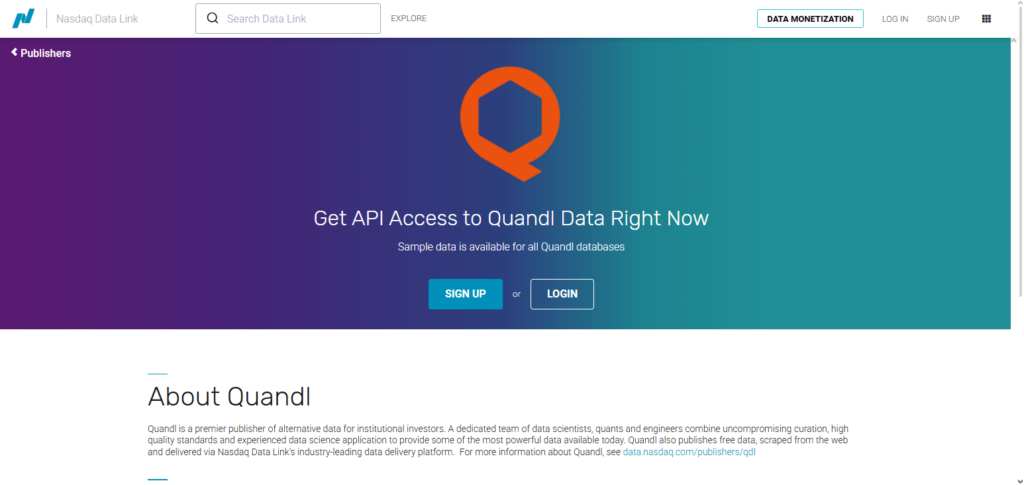
It is also very helpful for quantitative financial research. Nasdaq Data Link has excellent API service for its datasets enabling rapid integration of data.
| Pros | Cons |
|---|---|
| Provides easy API access to financial datasets. | Some premium datasets require additional payment. |
| Supports quantitative research and financial modeling. | Free datasets may have limited depth. |
| Offers alternative economic and market data sources. | Data quality varies between providers. |
| Developer-friendly platform with flexible integration. | Less suitable for traditional institutional workflows. |
| Useful for algorithmic trading applications. | Requires programming knowledge for maximum use. |
9. Alpha Vantage
Alpha Vantage has developed APIs for stocks, foriegn exchange, cryptocurrencies and economic indicators. The ease of access to their data solutions is impressive, especially to those building applications, trading tools, and research.
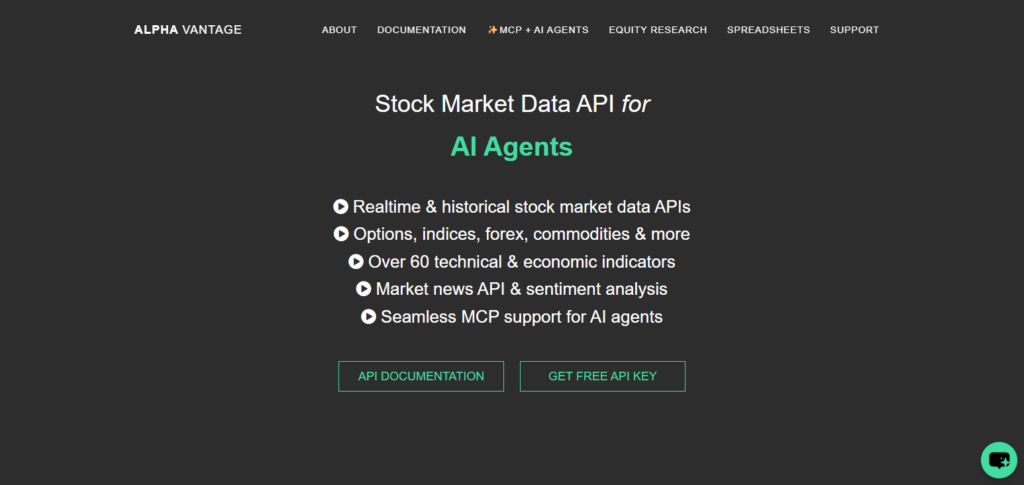
Alpha Vantage provides services to developers with machine learning-based technical indicators and automated data services, helping build customized financial applications and access global marketplace data.
| Pros | Cons |
|---|---|
| Provides affordable market data APIs for developers. | Free API usage has strict rate limits. |
| Covers stocks, forex, crypto, and economic indicators. | Not designed for institutional-level trading needs. |
| Easy integration with financial applications. | Real-time data availability may vary. |
| Offers technical indicators and historical data. | Advanced features require paid plans. |
| Suitable for startups and individual developers. | Limited enterprise support compared with premium providers. |
10. Tiingo
Tiingo combines equity APIs, trading research, and investment tools with dependable and cost-efficient data services. Tiingo provides stock and crypto prices, news, and historical market data. With its commitment to clear pricing and ease of use
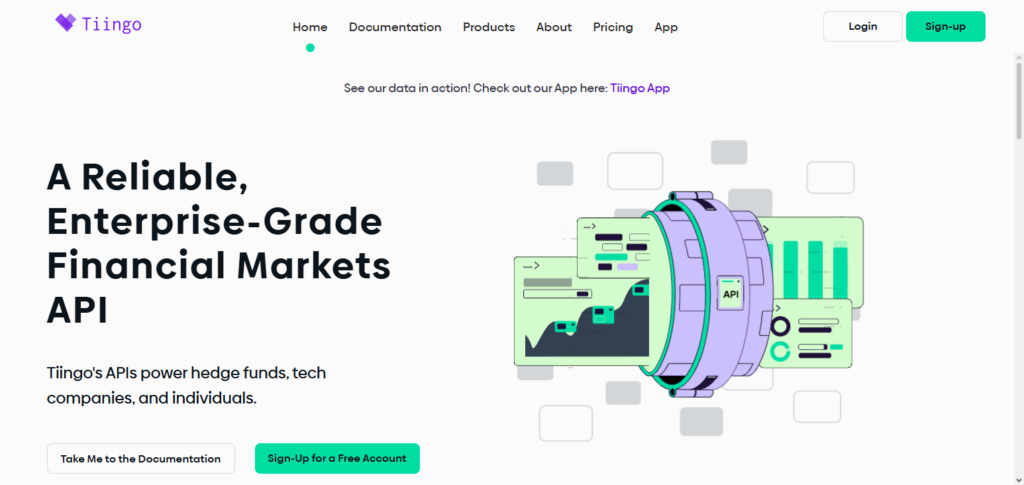
Tiingo is gaining popularity with developers, traders, and investors. Tiingo concentrates on data and is extending its market coverage to put premium market data in the hands of person investors and smaller financial teams.
| Pros | Cons |
|---|---|
| Offers affordable stock and cryptocurrency market data. | Smaller coverage compared with Bloomberg or Refinitiv. |
| Provides simple and developer-friendly APIs. | Limited institutional-grade analytics features. |
| Includes historical prices and financial news data. | Advanced datasets may require higher plans. |
| Good option for startups and independent traders. | Less suitable for large financial institutions. |
| Transparent pricing and easy platform usability. | Limited global market coverage compared with competitors. |
Future Trends in Market Data Providers
- More AI Market Analysis – Data and pattern analysis will be quicker along with predictive investing due to new advancements in AI.
- Faster, Real-Time Predictions – Market models will be able to give faster predictions due to the latest and most comprehensive data available.
- New Blockchain Financial Data Systems – Enhanced security, transparency, and data verification will be seen with the usage of blockchain.
- More Non-Traditional Datasets – Social, behavioral, and satellite data will be offered more widely.
- More Cloud Market Data – Market data will be quicker and more readily available due to new cloud solutions.
- More Automated Markets – Automation will enhance trading, data, and even efficiency in processing.
Conclusion
In this conclusion of the segment on the Best Market Data Providers, we see how this knowledge assists traders and investors, as well as financial institutions, in their need for trustworthy insights, precise pricing, and sophisticated analytics.
Bloomberg, Refinitiv, FactSet, and other leading platforms offer traders some of the best market research and decision-making tools. As developments in AI and cloud technologies and alternative datasets continue to proliferate, market data providers will be instrumental in developing financial strategies that promise to be much faster, more efficient, and more effective.
FAQs
They help investors make accurate decisions using reliable and real-time market insights.
Bloomberg Terminal, Refinitiv Eikon, and FactSet are among the top providers.
They provide stock, forex, crypto, commodity, economic, and company data.
Yes, traders use them for analysis, strategy building, and risk management.

