



This article covers the best Market Data Providers that offer real-time, accurate market data, analytics, and insight for businesses, investors, and traders, as well as financial technology developers.
Useful market data includes stock prices, economic data, and trading data and can be accompanied by research tools. Here we highlight relevant tools and resources.
What Is Market Data?
Market data is data that contains stock prices, volumes of trades, currency prices, values of commodities, and economic indicators. Important and useful data market data are employed by investors, traders, corporations, and market institutions, who depend on it for identifying market fluctuations and making educated decisions.
Specialized providers, APIs, and financial platforms that aid investment and trading research and tactics can deliver market data as it is collected (real time) or after it is collected (historical data).
Why Businesses Need Market Data Providers
- Refined Research and Analytical Capabilities for Investments: Data vendors give the ability to obtain correct financial data to help analyze the market, potential investments, and companies.
- Support for Algorithmic Trading Strategies: Automated trading systems can be employed through the use of market data coupled with time-sensitive data and signals.
- Advancement in Decisions Related to Portfolio Management: Offers the ability to evaluate the impact of investments on the portfolio and analyze the risk and return.
- Improvement in Financial Forecasting: Provides the ability and flexibility to make predictions based on data analysis of economic conditions and previous data.
- Support for Application of Financial Technology and Tools: Supports fintech solutions and technologies, trading systems, investment applications, dashboards, and other financial tools.
Key Points & Best Market Data Providers
| Market Data Provider | Explanation |
|---|---|
| Bloomberg Terminal | Provides real-time financial data, analytics, news, and professional investment insights worldwide. |
| Refinitiv Eikon | Delivers market data, research, analytics, and trading solutions for professionals globally. |
| FactSet | Offers financial intelligence, portfolio analytics, and investment research tools for institutions. |
| S&P Global Market Intelligence | Provides financial, economic, and industry data supporting informed investment decisions. |
| Morningstar Direct | Delivers investment research, portfolio analysis, and fund evaluation solutions efficiently. |
| Alpha Vantage | Provides API-based stock, forex, cryptocurrency, and market data services. |
| Polygon.io | Offers real-time financial APIs covering stocks, options, forex, and crypto. |
| Nasdaq Data Link | Provides alternative datasets, economic indicators, and financial information for analysis. |
| Twelve Data | Delivers global market data APIs for stocks, forex, and cryptocurrencies. |
| IEX Cloud | Provides developer-friendly financial APIs with reliable stock market information. |
10 Best Market Data Providers
1. Bloomberg Terminal
As one of the most powerful market data platforms, Bloomberg Terminal has an almost endless supply of tools and features for its users. It allows users access to real-time info on market prices
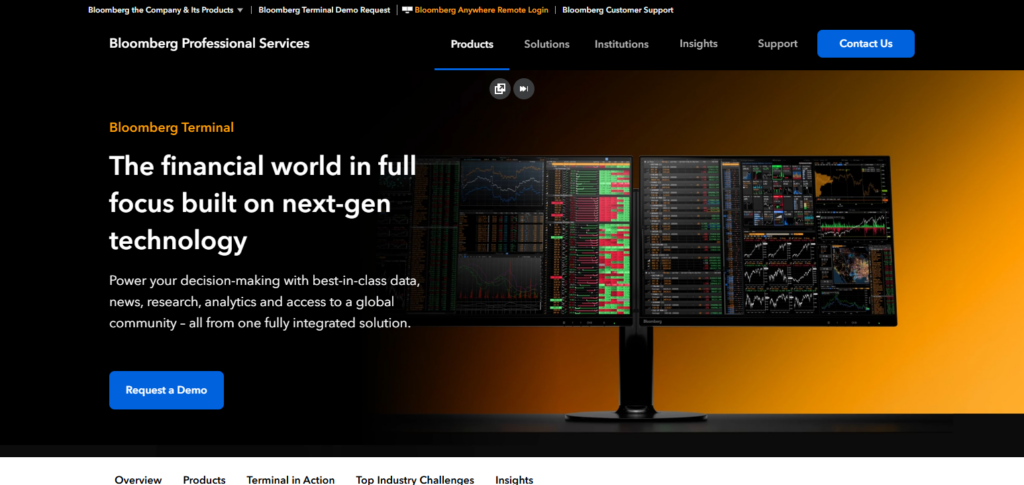
key economic indicators, company analysis, and even the latest breaking financial news. Because of its vast and comprehensive database covering equities, bonds, and other derivatives, it is the most popular data analytic solution among banks, hedge funds, and other institutional investors around the world.
| Pros | Cons |
|---|---|
| Provides unmatched real-time financial data and global market coverage. | Extremely expensive subscription limits access for small investors. |
| Offers advanced analytics, research tools, and professional trading insights. | Interface can feel complex for beginners and new users. |
| Includes reliable financial news and economic information worldwide. | Requires training to fully utilize advanced features effectively. |
| Supports multiple asset classes including stocks, bonds, and commodities. | High costs may not suit individual traders or startups. |
| Trusted by major financial institutions and investment professionals globally. | Limited customization compared with some modern data platforms. |
2. Refinitiv Eikon
Now part of the London Stock Exchange Group (LSEG), Refinitiv Eikon is one of the most popular platforms for market data and financial analytics. With its advanced analytics capabilities, Eikon provides users with easy access to real-time company fundamentals, economic data, and even data pertaining to trades.
Eikon covers the entire world of finance and is capable of analyzing data from equities, fixed income, commodities, and currencies. The platform also features advanced charts and user friendly customizable dashboards.
| Pros | Cons |
|---|---|
| Provides comprehensive financial data across global markets and industries. | Subscription pricing is expensive for smaller organizations. |
| Offers powerful research, analytics, and trading capabilities. | Learning curve can be challenging for beginners. |
| Integrates real-time news with market information effectively. | Some users report slower performance with large datasets. |
| Supports equities, currencies, commodities, and fixed-income markets. | Requires professional knowledge to maximize platform features. |
| Backed by LSEG with strong financial market credibility. | Advanced tools may require additional paid packages. |
3. FactSet
FactSet is another well known provider of financial data and analytics. Users can access market data along with analysis and tools for company fundamentals all from a single workspace. Because of its comprehensive market data and analysis
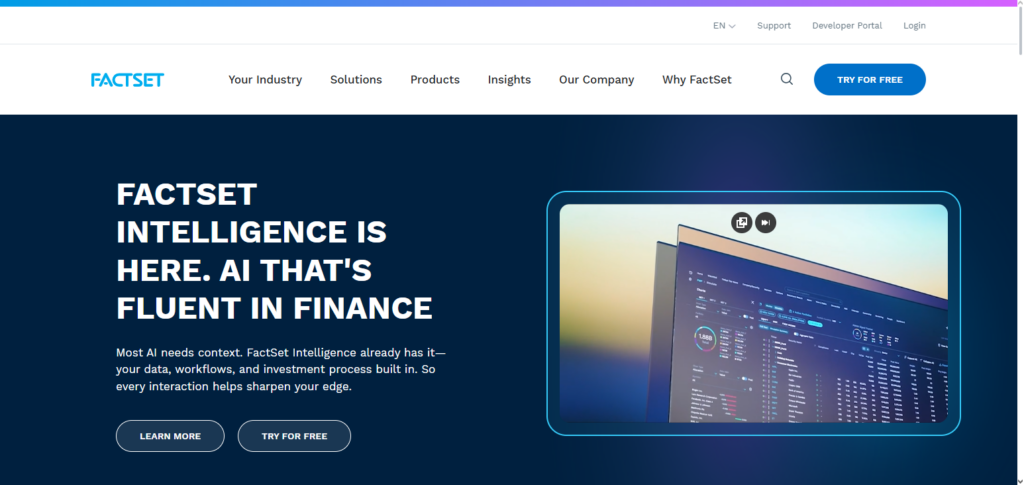
FactSet is also popular among asset managers and other wealth management firms and even analysts for their investment research. The latest features driven by artificial intelligence are aimed at enhancing user experience and lowering the challenges faced by users while accessing financial information.
| Pros | Cons |
|---|---|
| Provides detailed financial analytics and investment research solutions. | High pricing makes it unsuitable for casual users. |
| Combines multiple financial datasets into one platform. | Interface requires training for new analysts. |
| Offers strong portfolio management and valuation tools. | Limited accessibility for individual investors. |
| Includes AI-powered workflow improvements and automation features. | Some datasets may require additional subscription costs. |
| Trusted by asset managers and institutional investors worldwide. | Less focused on real-time trading compared with competitors. |
4. S&P Global Market Intelligence
S&P Global Market Intelligence offers rich financial, economic, and industry-related datasets around the globe. Their market intelligence includes profiles, market data, credit assessments, research, and alternative datasets. Global asset managers, banks, and many agency clients use their offerings for strategic and operational decisions.

S&P GMK Intelligence augments conventional datasets and analytics with advanced AI and machine learning. Clients are able to analyze and assess market conditions, identify and quantify risk, and identify opportunities to invest in various market segments.
| Pros | Cons |
|---|---|
| Offers extensive financial, economic, and industry research data. | Premium pricing targets enterprise-level customers. |
| Provides reliable credit ratings and company information. | Platform complexity may overwhelm new users. |
| Supports advanced risk analysis and market forecasting. | Requires specialized knowledge for deeper analytics. |
| Includes valuable alternative datasets for investment decisions. | Some features are available only in higher plans. |
| Trusted source for global financial intelligence and insights. | Not ideal for small-scale personal investors. |
5. Morningstar Direct
Morningstar Direct is investment research software with a focus on portfolio and fund analytics and asset management solutions. It includes a plethora of information on investment vehicles including mutual funds, ETFs, and equities, as well as investment styles.
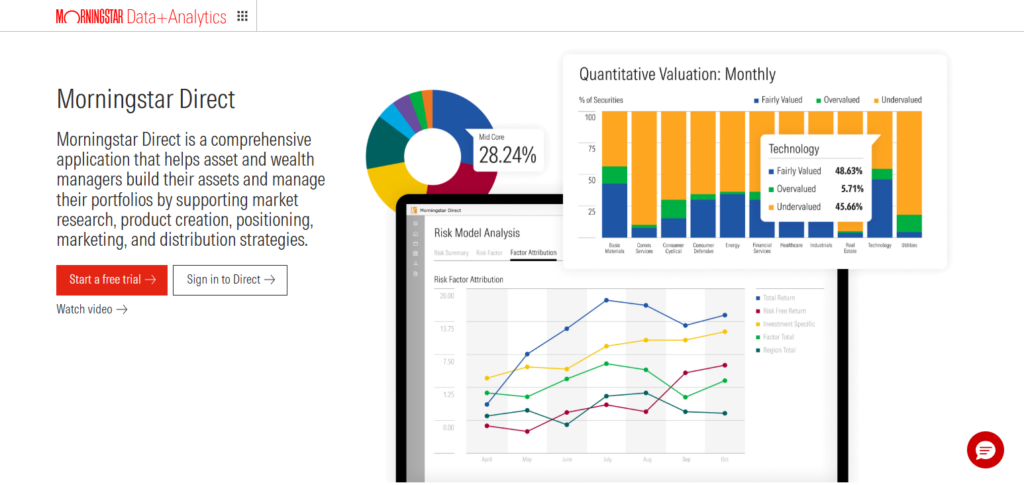
Morningstar Direct is used by financial and investment professionals to assess and analyze risk and return, and build bespoke portfolios. The software is highly extensible and continues to improve with the addition of new reporting and analytic features, and sustainability info, which all aid investment professionals make rational decisions in evolving markets.
| Pros | Cons |
|---|---|
| Provides excellent investment research and portfolio analysis tools. | Mainly focused on investment research rather than trading. |
| Strong coverage of mutual funds and ETFs worldwide. | Expensive for individual investors and small advisors. |
| Offers powerful risk assessment and performance comparison features. | Limited real-time market data compared with Bloomberg. |
| Includes sustainability and ESG investment insights. | Advanced features require professional expertise. |
| Trusted by financial advisors and asset managers globally. | Less suitable for high-frequency trading strategies. |
6. Alpha Vantage
Alpha Vantage is a go-to API market data provider for many developers, fintech firms, and financial app companies. With Alpha’s APIs, app builders can source stock, foreign exchange, and cryptocurrency data, and even app economic data.
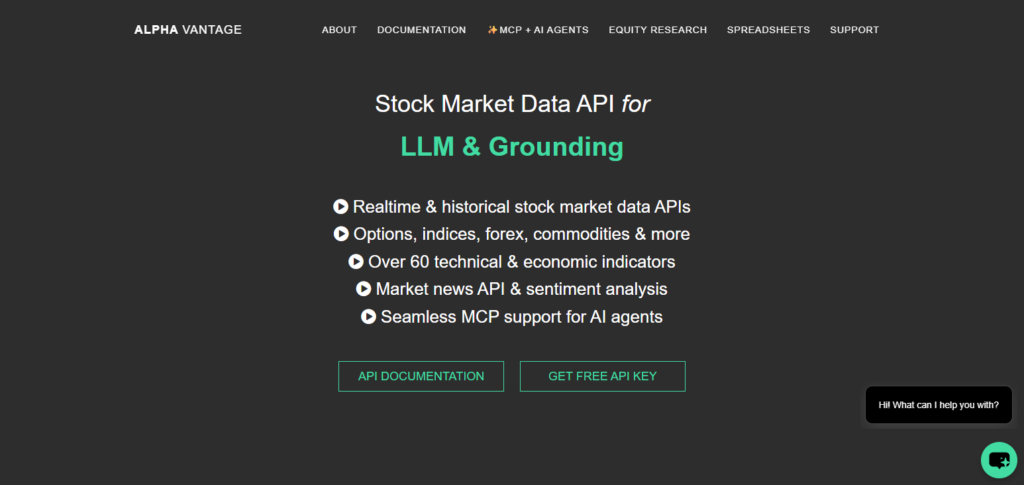
Their APIs are highly affordable and documented. Startups seeking market data for their apps have recognized Alpha Vantage as a valued source.
| Pros | Cons |
|---|---|
| Provides affordable API access for developers and startups. | Free plans have strict API usage limitations. |
| Supports stocks, forex, crypto, and economic datasets. | Data speed may not match institutional providers. |
| Easy integration with financial applications and platforms. | Limited advanced analytics compared with premium services. |
| Offers extensive documentation for API developers. | Real-time data availability depends on subscription level. |
| Suitable for fintech projects and research applications. | Customer support options are relatively limited. |
7. Polygon.io
For real-time and historical data for the markets of stocks, crypto, options, forex, and more, APIs are available through Polygon.io. Polygon.io is popular with developers, traders, and fintech companies for its fast, low-latency data, market summaries, and detailed trade and history datasets.
Its scalable infrastructure and easy API integration provide support for Polygon.io based systems for automated trading, analytics, and research in financial markets.
| Pros | Cons |
|---|---|
| Provides fast real-time market data through reliable APIs. | Premium pricing may challenge small developers. |
| Supports stocks, options, forex, and cryptocurrency markets. | Requires technical skills for API implementation. |
| Offers low-latency data suitable for trading applications. | Some advanced datasets require expensive plans. |
| Provides detailed historical market information and analytics. | Less suitable for non-technical users. |
| Popular among fintech developers and algorithmic traders. | Coverage varies across international markets. |
8. Nasdaq Data Link
For financial, economic, and alternative datasets, and for APIs the go-to for analysts and developers is Nasdaq Data Link. Among its thousands of datasets, one can find market data, company data, commodity data, and economic indicators.
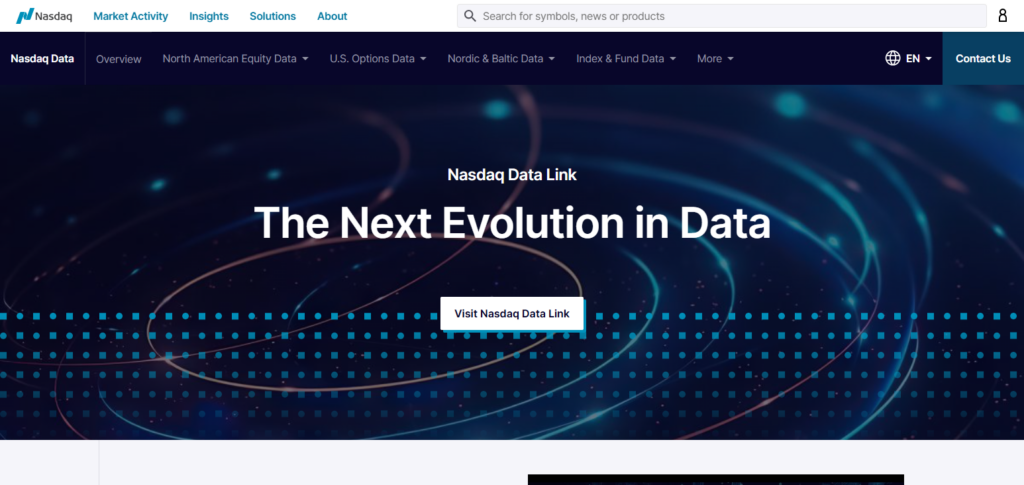
Along with its growing alternative data, Nasdaq Data Link enables analysts, investors, and companies to discover new and useful data to help in their analyses.
| Pros | Cons |
|---|---|
| Provides thousands of financial and alternative datasets. | Data quality depends on individual dataset providers. |
| Offers API access for developers and researchers. | Premium datasets can become expensive. |
| Supports economic research and investment analysis. | Not primarily designed for real-time trading. |
| Includes unique alternative data sources for forecasting. | Requires expertise to interpret complex datasets. |
| Backed by Nasdaq’s trusted financial ecosystem. | Platform navigation may require learning time. |
9. Twelve Data
Twelve Data APIs advance the developer tools market for stocks, crypto, indices, forex, and ETFs. Its fast integrations appeal to developers of financial services, trading, and investments solutions, for accurate market data.
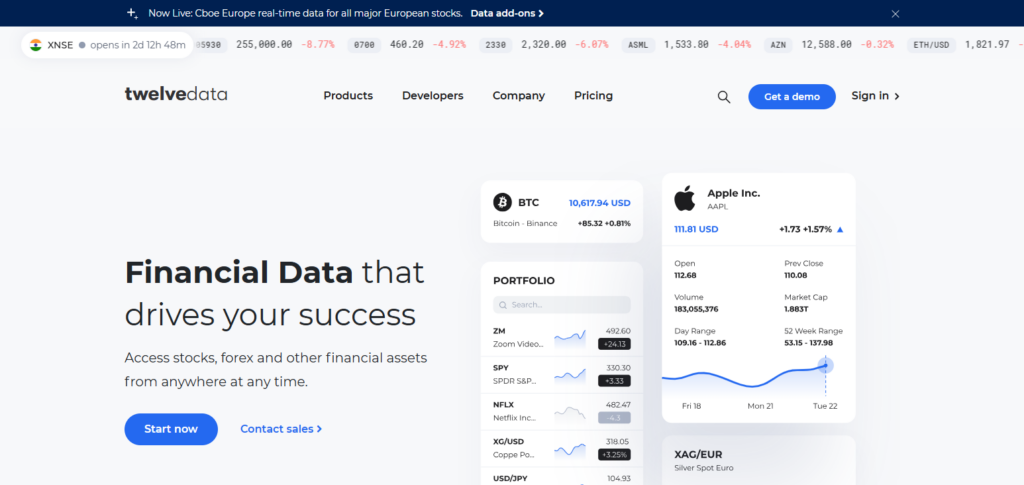
Twelve Data is also known for easy APIs and a fast integration for real-time data and history. Twelve Data remains a popular service for modern fintech solutions.
| Pros | Cons |
|---|---|
| Provides global market data through simple APIs. | Free plan includes limited requests and features. |
| Supports stocks, forex, crypto, and ETFs. | Advanced analytics require paid subscriptions. |
| Easy integration for fintech applications and developers. | Data coverage may vary by region. |
| Offers real-time and historical market information. | Not as comprehensive as institutional platforms. |
| Provides flexible pricing options for different users. | Limited research tools compared with premium providers. |
10. IEX Cloud
IEX Cloud is a data API that developers and businesses are able to use to create applications that work in the market. Their APIs include stock prices, company fundamentals, financial statements, and market reference data.
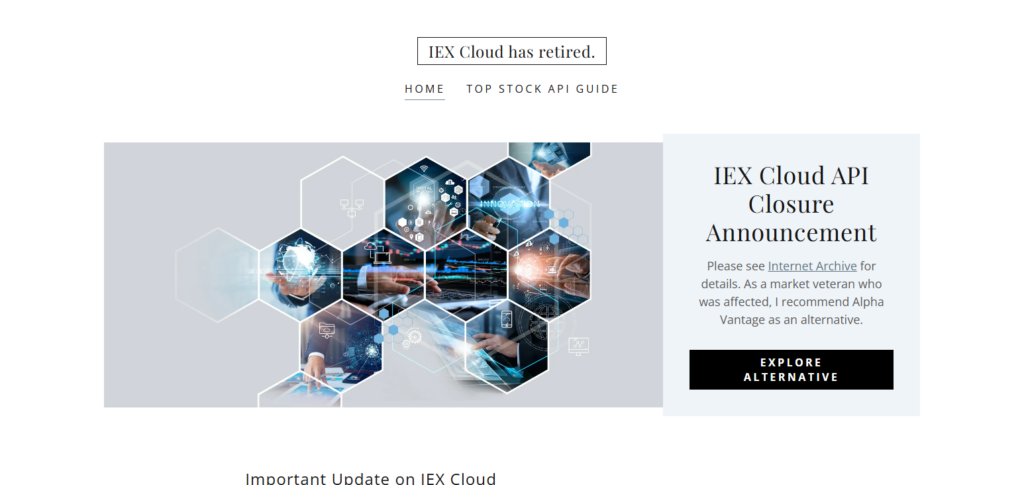
Their focus is on the transparency, speed, and accessibility on the part of the fintech companies, researchers and investors. Their APIs are easy to integrate and their data services are highly scalable.
| Pros | Cons |
|---|---|
| Provides reliable financial APIs for developers and businesses. | Limited global market coverage compared with competitors. |
| Offers transparent and accessible market data solutions. | Best suited for developers rather than analysts. |
| Includes stock prices and company fundamentals data. | Advanced features may require technical knowledge. |
| Easy integration with financial applications and dashboards. | Smaller dataset ecosystem than major providers. |
| Supports scalable fintech and investment technology solutions. | May not satisfy institutional research requirements. |
Conclusion
In Conclusion Best Market Data Providers Choosing the appropriate market data provider allows businesses, traders, and investors to gain access to factual financial data and make better decisions. The top four market data providers, such as the Bloomberg Terminal, Refinitiv Eikon, and FactSet, as well as other API-based data providers, offer robust analytical tools and real-time, comprehensive market data.
As the financial services sector continues to evolve, so will the demand for the best market data providers, particularly for investment research and trading. The same will be true for the market data providers that support the continued evolution of the financial technology sector.
FAQ
Bloomberg Terminal and Refinitiv Eikon are popular choices among financial professionals due to advanced analytics, research, and global market coverage.
They provide stock prices, forex rates, cryptocurrency data, commodities, company fundamentals, economic indicators, and historical market information
Alpha Vantage, Polygon.io, Twelve Data, and IEX Cloud are suitable for developers needing reliable financial APIs.
Yes, they provide APIs and financial datasets that help fintech companies build trading platforms, investment apps, and analytical tools.

